


Laura Stevens (they/them)
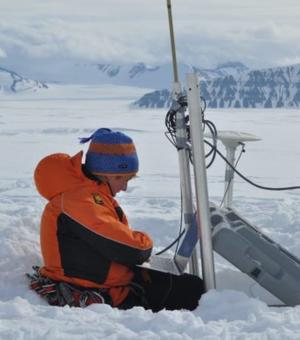
My research program aims to determine how ice sheets flow and fall apart. Understanding ice sheet dynamics on Earth is critical for the prediction of past and future global ice volumes, which have direct implications for global sea level. At present, the question that drives our research is: How does ice-sheet melting modulate ice-sheet flow? To approach this question, we pair geophysical observations with time-dependent inverse methods and computational modeling. We investigate Greenland and Antarctic ice sheet, ice shelf, and outlet glacier flow dynamics to better understand the physical mechanisms that destabilize ice sheets with increased surface meltwater production in our warming climate.
First Year: Modern Climate Processes -- Cryosphere & Sea Level; Probability & Statistics for Earth Scientists
Second Year: Climate Change
Third Year: Climate Dynamics
Fourth Year: Topics in Climate Sciences
Intelligent Earth CDT: Natural Hazards
Link to CV (June 2026):

UNDERSTANDING SURFACE-TO-BED MELTWATER PATHWAYS ACROSS THE GREENLAND ICE SHEET USING MACHINE-LEARNING AND PHYSICS-BASED MODELS
Jointly supported by the US NSF and UK NERC, this project will begin in September 2023 and aims to better understand surface-to-bed meltwater pathways across the entire Greenland Ice Sheet using machine-learning and physics-based models. The three-year project will use a combination of remote-sensing observations, deep learning, and physics-based models with aims to: (1) detect continent-wide surface fractures, moulins and supraglacial lake drainage events within satellite imagery; (2) determine the ice-sheet conditions required to trigger supraglacial lake drainage via hydrofracture; and (3) model the impact of supraglacial lake drainage events on ice-flow dynamics at a regional scale. Lead by Prof. Ching-Yao Lai (Stanford U.), additional collaborators include Profs. Leigh Stearns (U. Kansas) and Ian Hewitt (U. Oxford Mathematical Institute). Previous work that motivates this proposal is published in Lai et al. (2021) and Stevens et al. (2015; 2018).
ANTARCTIC ICE-SHELF INSTABILITY CAUSED BY ACTIVE SURFACE MELTWATER PRODUCTION, MOVEMENT, PONDING, AND HYDRO-FRACTURE.
Funded by NSFGEO–NERC, this project combines field observations, numerical modeling, and remote sensing techniques to better understand ice-shelf flexure and fracture due to surface meltwater loading. Field observations of ice-shelf surface height, local weather conditions, and water body depths are currently being collected on the George VIth Ice Shelf, Antarctic Peninsula through February 2023. This project is jointly supported by the US NSF and UK NERC, with field support provided by the British Antarctic Survey in coordination with the United States Antarctic Program. Collaborators include Prof. Alison Banwell (Northumbria University), Rebecca Dell (University of Cambridge), Douglas MacAyeal (University of Chicago), and Ian Willis (University of Cambridge).
In the Earth Sciences department, I am a Mental Health First Aider, the faculty lead for the LGBTQIA+ Affinity Group, and the Deputy Directory for Graduate Studies. I am on the leadership team for the UKRI AI Centre for Doctoral Training in AI for the Environment — Intelligent Earth.


