


Molecular Spectroscopy Facility
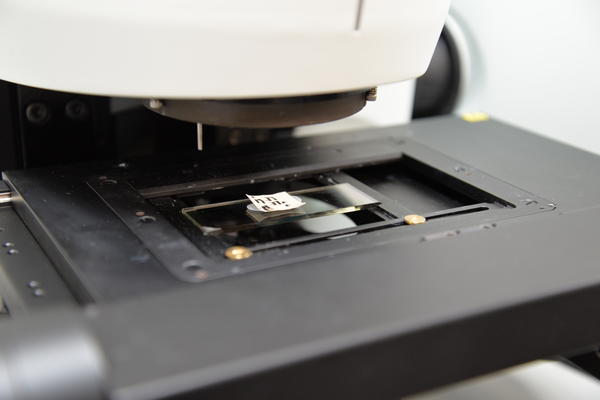
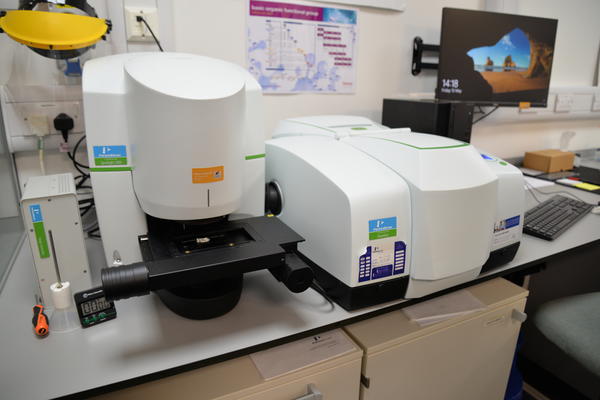
Our Molecular Spectroscopy Facility provides analytical services for users both within and beyond the University of Oxford. We host a mid-IR Perkin Elmer Frontier Fourier-Transform Infrared (FTIR) Spectrometer equipped with a Diffuse Reflectance (DRIFTS) accessory and a Spotlight 200i Microscope with a motorized stage. FTIR uses an incident infrared beam to induce vibrations of the molecular bonds within a sample, allowing the user to identify different bond types in a specific wavelength region. The method is conventionally used to study organic materials, either bio- or abiogenic in nature. Our set-up features a confocal Spotlight microscope with a liquid-nitrogen cooled MCT detector, which is allows for non-destructive study of minerals (incl. hydrous/CO2-bearing) or organic matter with little to no sample preparation, and allows for depth profiling and targeting subsurface objects (i.e., inclusions) as well as automated mapping in either transmittance or reflectance mode.
Key Features
- Analysis of powdered samples – either in conventional transmission (KBr pellets) or reflectance (by DRIFTS) mode – as well as in-situ in either mode (using Spotlight)
- Functional group detection (and cross referencing against spectral libraries, for polymer compounds)
- Spectral resolutions of 1 to 4 cm-1
- Supports analytical areas as small as ~10 x 10 microns
- Spatial mapping of heterogeneous samples
Sample Requirements
KBr pellet or DRIFTS analysis can be performed on any powdered solid containing natural or modified/synthetic organic material. Samples should be ground to a grain size of <30 microns.
For in-situ analysis by Spotlight, samples can be unmodified for reflectance analysis. For transmittance work samples must be placed on IR-inert substrate/window and be of appropriate thickness to minimise absorbance (<30 microns for best results).
Applications
FTIR is a flexible technique, allowing study of bonding environments and functional groups in a wide range of materials, including:
- Synthetic compounds (fibres, polymers, pharmaceuticals, biomedical)
- Minerals, gemstones, soils, sediment, regolith (pulverised by KBr/DRIFTS, in-situ grains, chips or sections by Spotlight) for phase ID, weathering and contamination screening
- Fossils or organic-rich natural materials (kerogen, hydrocarbons, phosphates, altered biogenic phases)
- Fluid and melt inclusion, and experimental or natural glass contents (H2O, CO2 +/- other volatiles i.e., SOx, NOx)
- Verification of ornamental, archaeological and other cultural heritage materials (i.e., study of ink, dye or pigment composition)
How We Can Support You
We can offer advice at any stage of the research process, including:
- Advice on potential research approaches at the initial stages of inquiry
- Logistics and scheduling
- Aid in sample preparation
- On-instrument training (including liquid nitrogen handling) and support in data collection
- Data interpretation with Perkin Elmer’s Spectrum software, including several proprietary databases of polymers, and the import of other reference data
Contact Information
Interested in using the Molecular Spectroscopy Facility?
For rates, training, or to schedule use, please contact Kris Sokół at krzysztof.sokol@earth.ox.ac.uk.

