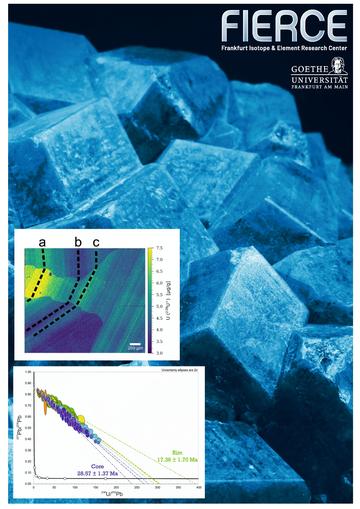
The largest source of ambivalence in reconstructing geological processes likely is the uncertainty in determining the timescales and rates at which they occur. Absolute dating using radioisotopes continues to elucidate this aspect, but most efforts in radio-isotope dating were historically restricted to targeting U-rich accessory minerals, such as zircon, monazite, rutile and allanite. Age-dating these minerals regularly produces highly-reliable results, but the approach has some handicaps: (1) not every rock contains accessory minerals, (2) many of them tend to form late in the tectonic history of the rock or continue to chemically exchange Pb with their environment during cooling, and (3) in a metamorphic rock it may be difficult to connect their age information to any particular event in the formation history of the rock. At FIERCE we extend the U–Pb method to rock-forming minerals with very low U concentrations (<<1 µg/g), with a focus on carbonate and garnet.
Garnet-group minerals are an integral part of many well-established geobarometers and geothermometers and, combined with geochronometry, hold the potential as an “ultimate petrochronometer” – i.e. providing an archive of P−T−t history in a widespread rock-forming mineral that is easy to recognize and reliable as a recorder of chemical and isotopic signals. Apart from their abundance in metamorphic rocks, minerals of the garnet supergroup are also abundant in many hydrothermal ore deposits (skarns), in many pegmatites and alkaline volcanic and plutonic rocks and in clastic sediments as detrital heavy minerals.
The instrumental setup at FIERCE coupling laser-ablation with a modern multi-collector ICPMS system enables us to routinely extract U–Pb ages even for garnet with extremely low U content (low ng/g to sub-ng/g levels of [U]) at a geologically meaningful level of precision comparable to those expected from accessory-mineral geochronometers. Our results demonstrate that the U–Pb system in garnet has a closure temperature at the extreme end of what is reached during crustal metamorphism. Consequently, garnet U–Pb ages from crustal metamorphic rocks have to be interpreted as crystallization ages. Garnet U–Pb dating by laser-ablation-ICPMS provides accurate, precise, spatially resolved and geologically meaningful insight into the P–T–t history of (poly)metamorphic terrains.
Venue
Seminar rooms
If you are external to the Department of Earth Sciences and wish to receive information about departmental seminars please join our mailing list by sending a message to: earth_sciences_seminar-request@maillist.ox.ac.uk