


Super-shear Earthquakes on Long Straight Faults
CONFERENCE PROGRAMME
September 22, 2026
SESSION 1
9:00 – 9:20: Prof. Shamita Das, University of Oxford: Welcome & Introduction
9:20 – 9:45: Prof. Mike Searle, University of Oxford:
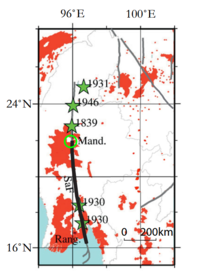
Geological history of the Sagaing Fault, Myanmar
9:45 – 10:15: Prof. Ralph Archuleta, University of California, Santa Barbara:
A Personal Perspective on the Developments of Supershear Rupture Velocity
10:15 – 10:45: Prof. Alice Gabriel, University of California, San Diego:
On the Predictability of Slip, Rupture Geometry, and Speed of the 2025 Mw 7.8 Mandalay, Myanmar, Earthquake
10:45 – 11:15 Prof. Hongfeng Yang, The Chinese University of Hong Kong:
Supershear indicators from near-fault data records
SESSION 2
11:45 – 12:15: Prof. Liu Gang, China Earthquake Administration:
Late-stage supershear rupture in the 2021 Mw 7.4 Maduo, China earthquake
12:15 – 12:45: Dr Marion Thomas, Université de Rennes:
Signature of rupture dynamics in off-fault damage
12:45 – 13:15, Prof. Michel Bouchons, CNRS — ONLINE:
Some remarks on faulting characteristics of recent supershear earthquakes
14:30 – 15:00: Dr Camilo Pinilla-Ramos, GFZ:
What drives ground motions in supershear rupture propagation? Analyzing and isolating the contribution of the source time functions and rupture time function
15:00 – 15:30: Dr François Passelègue, Géoazur, Université Côte d’Azur
Direct estimation of earthquake source properties from a single CCTVcamera (2025 Mw 7.7 Mandalay earthquake, Myanmar)
15:30 – 16:00: Prof Omar Perez, Simón Bolívar University, Caracas, Venezuela — ONLINE:
The Caracas, Venezuela, Holy Thursday earthquake of 26 March 1812 and its repeat on 26 June 2026.
16:00 – 16:30: Dr Dara Goldberg, U.S. Geological Survey — ONLINE:
Early identification of atypical rupture characteristics: A rapid response perspective
16:30 – 17:00: Discussion and conclusions on day’s topics
September 23, 2026
SESSION 3: Laboratory experiments on super-shear rupture
9:30 – 10:00: Prof Ares Rosakis, Caltech:
Friction, Not Fracture: Healing Controls Frictional Energy and Rupture Dynamics While Allowing Young Faults to Transition to Supershear over Short Fault Segments
10:00 – 10:30: Prof. Alexandre Schubnel, CNRS / Laboratoire de Géologie, École Normale Supérieure
High-frequency radiation and energy budget of laboratory supershear earthquakes
10:30 – 11:00: Dr Cedric Twardzik — Géoazur, Université Côte d’Azur
Early moment-rate growth scales with rupture velocity during laboratory earthquakes
11:30 – 12:00: Dr Kurama Okubo, National Research Institute for Earth Science and Disaster Resilience (NIED), Japan:
Dynamic Rupture Modeling and Far-Field Radiation of the 2026 Venezuela Earthquake Sequence
12:00 – 12:30: Dr Suli Yao, Laboratoire de Géologie, École Normale Supérieure, CNRS:
Inversion of Near-Fault Velocity Pulses for Local earthquake Rupture Dynamics
12:30 – 13:00: Prof. Harsha Bhat, CNRS, École Normale Supérieure & École Polytechnique:
Single-station seismology and coseismic damage
13:00 – 13:30: Discussions, Conclusions and Future Research Directions

