

Earth Sciences in Conversation: Julie Cosmidis

Our Earth Sciences in Conversation series explores the lives and careers of members of the Department, showing readers the people behind our world-leading research. For this issue we sat down with Julie Cosmidis, Associate Professor of Geobiology, to discuss how microbes transformed the Earth’s atmosphere, how they could help secure the critical minerals needed for the energy transition, and why some bacteria grow tiny magnets inside their cells.
Interview by Charlie Rex
What (or who) inspired you to go into Earth Sciences?
I got into science through a discipline that’s actually quite different from what I do now. I’m a geomicrobiologist who studies interactions between microbes and minerals. But when I was a student in high school, there were really two things I was interested in: history and palaeontology. I’ve always liked thinking about the past, and in some ways palaeontology is just history in deep time. I became fascinated by human evolution, going back to the first hominids and trying to understand where we came from, and my interest grew from there. I was never the kind of child who collected rocks or was fascinated by volcanoes or dinosaurs, it was human evolution that drew me in. Even as a geology student, I never particularly enjoyed fieldwork or mapping, but it was a path I had to follow to get to the questions that interested me most [laughs].
Tell us about what you studied at university and your career path so far.
I went through the French university system, and one thing that’s distinctive about France is that geology and biology are taught together, so during my first years of study I was doing both subjects side by side. That’s really where I fell in love with biology and started thinking seriously about the connections between life and the Earth. Looking back, that’s what led me into geobiology. I studied in Lyon, then completed a PhD in Paris in geomicrobiology. At the time it was still a relatively new field, so it wasn’t something you really encountered as an undergraduate. During my master’s degree I discovered this idea of studying the interactions between life and Earth processes and completely fell in love with it. After my PhD, I moved to the University of Colorado, Boulder, for a two-year postdoc, which was a wonderful place to live and work. After that I joined Penn State University as an Assistant Professor for three years, before moving to Oxford in 2020.
You’ve studied in France, worked in the US, and now work in the UK. What differences have you noticed, and how have you found communicating your research in two different languages?
As a French PhD student, you have to write all of your scientific papers in English, so you’re learning scientific writing and the language at the same time. That’s definitely a challenge, and I think native English speakers have a real advantage there. But you get used to it. In fact, I’ve now been working in English for around fifteen years, and it’s actually harder for me to talk about science in French. Sometimes I’m invited to give seminars in France, and I find myself struggling to remember the French scientific terminology because I use the English words every day. In terms of the science itself, I think researchers work in fairly similar ways everywhere. What I do think Europe does slightly better is work-life balance. There’s a lot of energy and excitement in the US, and people work incredibly hard, but they don’t always know how to take a proper break.
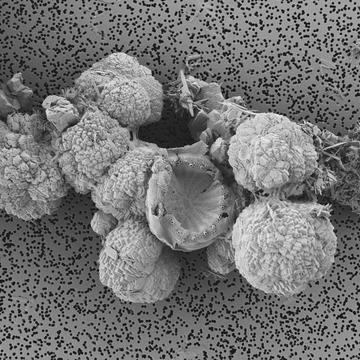
SEM image of carbonate minerals formed by a diatom (C. cryptica) (Image Credit: Mbere Umoh)
Was there a particular moment when you decided to pursue academia as a career?
I can’t really point to a single moment. What attracted me to academia was the idea that you get to remain a student your whole life. You keep learning, every day, about things that genuinely interest you. I’m still amazed that I get paid to do this job. If it wasn’t my profession, it would probably be my hobby [laughs]. I would still be reading about science and thinking about the kinds of questions I work on now. Of course, there are aspects of the job that feel like hard work, but there are also many moments where you stop and think, “I can’t believe I’m allowed to do this for a living.”
For those unfamiliar with it, what is geobiology, and why is it important?
Geobiology is a very broad field. I’d describe it as the study of the interactions between the geosphere and the biosphere across geological timescales. It covers a huge range of topics, and my own work focuses on one small part of it: geomicrobiology, which is the study of microbes and how they interact with their environment, both today and in the past. What fascinated me about microbes is how dominant they really are. If an alien visited Earth and looked at the planet in terms of the number of different species, they would probably conclude that Earth is primarily a microbial planet. The overwhelming majority of biological diversity is found in bacteria and archaea. Even in terms of biomass, after plants, bacteria account for more biomass than animals. Microbes play fundamental roles in geochemical cycles and environmental processes, so understanding what they are, what they do, and how they shape the planet is incredibly important. That’s really what geobiology is about.
What are the big questions that drive your research?
My group works on a process called biomineralization, which is how microbes produce minerals. We’re trying to understand how those processes work, what impact they have on chemical cycling in the environment, and how we can use the minerals they produce to learn about the history of life on Earth. Bacteria themselves don’t fossilise particularly well. They’re tiny, they don’t have bones or shells, and most of the time they disappear from the geological record. But the minerals they produce can survive for billions of years. One of the big questions we’re interested in is whether we can use those minerals as signatures of ancient microbial activity. For most of Earth’s history, all life was microbial. The first couple of billion years of life on Earth were dominated by tiny single-celled organisms, and much of that record is difficult to access directly. These biominerals may provide some of the clues we need to reconstruct that lost history.
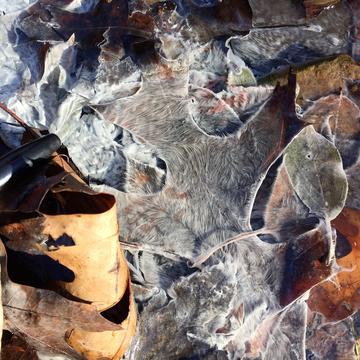
Leaves covered by biofilms of sulfur-biomineralising bacteria (white fluffy filaments)
Microbes have had a huge impact on shaping Earth as we know it. Can you give us an example?
The most spectacular example is probably the Great Oxidation Event around 2.4 billion years ago. Before that point, Earth’s atmosphere contained very little oxygen. Then, relatively rapidly in geological terms, oxygen levels began to rise. We think this was driven by cyanobacteria evolving oxygenic photosynthesis, the same process used by plants today. These microbes were taking carbon dioxide and turning it into biomass, releasing oxygen as a by-product. That single biological innovation completely transformed the surface of the planet, taking it from a largely reducing environment to an oxidising one. It’s one of the best examples of how microscopic organisms can have planetary-scale consequences.
You’re part of Oxford EARTH. How does your research connect to challenges around critical minerals and resource sustainability?
Many microbes are incredibly good at cycling elements. Some can use iron oxides instead of oxygen to break down organic matter, effectively breathing iron rather than oxygen, which still amazes me. Across the full diversity of microbial life, microbes can cycle a huge range of elements, including metals that are important for the energy transition. One thing microbes are particularly good at is concentrating metals from very dilute sources. Many critical minerals exist in nature at extremely low concentrations, and it takes a lot of energy to extract and concentrate them using conventional industrial methods. Microbes have spent billions of years evolving molecular tools that allow them to bind, transport and concentrate specific metals very efficiently. My philosophy is that evolution has already solved many of these problems. Rather than reinventing those solutions through chemistry alone, we should ask how we can learn from microbes and use those biological strategies to develop more efficient and sustainable technologies.
What’s one thing about microbes that would surprise most people?
There are a group of organisms called magnetotactic bacteria. These microbes are quite common in lake sediments and rivers, and they produce tiny magnets inside their cells. If you look at them under a microscope, you can actually see these little magnets inside them. Chemically and structurally, they are extraordinary. They are probably the purest nanomagnets on Earth. We can’t manufacture magnets with the same degree of purity and perfection. The reason they make them is even more fascinating. These bacteria live at very specific oxygen concentrations, right at the transition between oxidised and reduced conditions. Finding that perfect position in the environment isn’t easy if you’re a tiny organism swimming around at random. The magnets allow them to use the Earth’s magnetic field as a guide. In effect, they can use the magnetic field to find the vertical and quickly move towards the depth where oxygen levels are exactly right for them. I think that’s just incredible.
Do you have a favourite sample or field site that you’ve worked on?
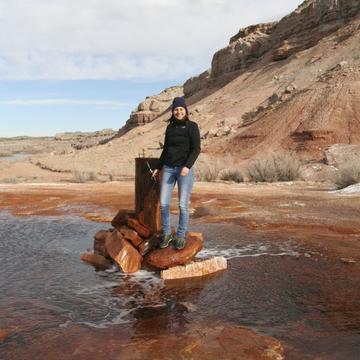
I don’t do a huge amount of fieldwork, but one site that really stands out is Crystal Geyser in Utah. It’s a very unusual geyser because it isn’t powered by heat and steam. Instead, it’s driven by large amounts of carbon dioxide dissolved in groundwater. The water rises from around 800 metres below the surface, becomes loaded with CO2, and eventually erupts when enough pressure builds up. The site is visually stunning because the water contains lots of dissolved iron. As it reaches the surface, that iron oxidises and precipitates as bright orange iron oxides, so the whole landscape is covered in vivid orange deposits. It looks almost extraterrestrial. I was there with a microbial ecologist friend who was interested in the deep biosphere. Because the water comes from so deep underground, it gives you direct access to microbial communities that normally remain hidden beneath the surface. What makes the site really special is that sequencing work carried out there revealed an entirely new phylum of life. A phylum is a huge branch on the tree of life, so discovering a completely new one from a single site was remarkable. It really highlighted how much microbial diversity remains unexplored.
Have there been mentors or role models who shaped your path?
Definitely. My PhD supervisor was the person who first opened the world of geomicrobiology to me. I met him while I was a master’s student in Paris, and before that I knew almost nothing about the field. He really provided the doorway into the subject. Then later, my postdoctoral supervisor, Alexis Templeton, was hugely influential. Both of them were brilliant scientists, but they were also genuinely kind people. I learned a great deal from them scientifically, but I also learned a lot about how to be a good colleague and a good person. Alexis was particularly important because she showed me that it was possible to have both a successful scientific career and a family. Having that example in front of me made a huge difference. It helped me believe that finding a balance between those things was actually achievable.
What advice would you give to students considering a research career in Earth Sciences or geobiology?
This is a difficult one because the environment young researchers face today is much more competitive than the one I entered. It would be easy to say, “Work hard, follow your passion, and everything will work out,” but I’m not sure that’s entirely realistic anymore. Passion and hard work are still essential, but I think students also need to be open and flexible. It’s important to be willing to explore different directions, different funding opportunities, and even different sectors. There is a lot of excellent science happening in industry, and many people have very fulfilling scientific careers outside academia. My advice would be to stay flexible, and be open to opportunities that might not fit your original plan.
What do you particularly love about Oxford?
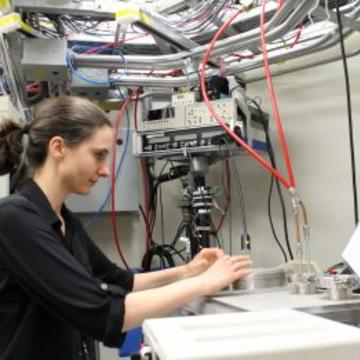
The Department is brilliant. The thing I appreciate most is that there are so many incredibly talented people who are also genuinely kind and supportive. It’s a very friendly place. Of course, it can be slightly intimidating because everyone is so good at what they do, but that’s also motivating. And then there’s the instrumentation. I think people here sometimes forget how fortunate we are. The facilities available in Oxford are extraordinary. We have access to some of the best microscopes and analytical equipment in the world. I know that isn’t something you can take for granted.
Can you tell us about something you’re currently working on?
The thing I’m most excited about right now is a new high-throughput method we’ve been developing for studying biomineralization. Traditionally, you would grow microbes in tubes, wait for them to produce minerals, and then analyse those minerals using several different instruments. It’s a slow process. What we’re trying to do is miniaturise and automate it. Instead of running a handful of experiments, we can now run ninety-six at once. We’ve built a workflow where we can image minerals directly inside the little wells on a plate, analyse them using Raman spectroscopy, and collect chemical and structural information without ever removing them from the plate. That allows us to generate vastly more data than before. One application is studying mutant libraries. We can create hundreds of microbial mutants, each carrying a different genetic change, and then see how those mutations affect biomineralization. If the minerals change, or stop forming entirely, we can identify which genes are involved in controlling the process. The exciting part is that this approach lets us ask questions at a scale that simply wasn’t possible before.
What excites you most about the future of geobiology?
Over the last few decades, we’ve made enormous progress in understanding microbial diversity. Thanks to advances in genomics, we now know far more about who these microbes are, where they live, and what they do. What excites me now is moving beyond that fundamental understanding and into applications. We know microbes can cycle metals, produce minerals, remediate pollutants and perform all sorts of remarkable chemical transformations. The challenge now is figuring out how to use that knowledge to solve real-world problems. Whether it’s extracting critical minerals, cleaning up contaminated environments, or developing more sustainable manufacturing processes, I think microbes have a huge amount to teach us. We face a lot of environmental and technological challenges as a society, and I believe geobiology is going to be increasingly important in helping address them.
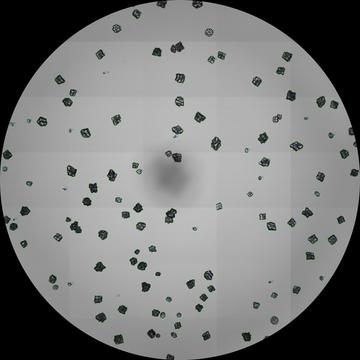
Optical image of carbonate minerals forming in-situ in a 96-well plate (Image Credit: Luca Stigliano)
What has been the proudest achievement in your career so far?
That’s a difficult question. Right now, I would probably point to the high-throughput biomineralization methods we’ve been developing. Not because I think the idea itself is particularly brilliant, but because I genuinely believe it has the potential to accelerate research in our field. It changes the way we can approach experiments and allows us to ask questions that would previously have been impractical. If I imagine myself looking back at my career many years from now, I think this is the work that may have had the biggest impact. Having said that, the real technical genius behind much of this development is my postdoc, Luca Stigliano. He has done an incredible amount of the work involved in building and refining the method, so I’m very proud of what he has achieved.
What motivates you as a researcher?
When I was a student, what excited me most was being in the lab, running experiments and discovering things myself. As a group leader, I don’t get to spend nearly as much time doing that anymore. Now my favourite day of the week is Thursday, because that’s when I meet with my group. I get to hear about all the things they’ve been working on, and they constantly surprise me. Someone has a brilliant new idea, somebody else has exciting results, and suddenly there’s a completely new direction to think about. That’s really what motivates me now. I genuinely look forward to hearing about the wonderful things the people in my group are doing.
If you could study any period in Earth’s history first-hand, which would you choose and why?
Definitely around four billion years ago, which is roughly when we think life originated. I would love to see what those earliest forms of life actually looked like. There’s still so much debate about when life appeared, how quickly it became complex, and what those first organisms were. We often talk about LUCA, the Last Universal Common Ancestor, which is the organism from which all modern life ultimately descends. What’s remarkable is that LUCA already appears to have been quite complex. If you look at the genes shared by all living organisms today, you can infer that LUCA already had DNA, proteins and sophisticated cellular machinery. Some studies place it at around four billion years ago, which is astonishingly early. That means life seems to have gone from chemistry to something already highly organised in a relatively short amount of time. For me, that remains one of the biggest mysteries in science. How does chemistry self-organise into something that is alive? If I could go back and see those pre-LUCA organisms, that would be extraordinary.
What’s your favourite piece of fiction that involves Earth Sciences?
There’s a science fiction series called The Expanse that I absolutely love. It’s set a few hundred years in the future, when Earth has become heavily overpopulated and humans have colonised Mars and the asteroid belt. What I find particularly interesting is that it’s really a story about resources. The people living in the asteroid belt are mining minerals and extracting water, while Earth and Mars depend on those resources. The series explores the politics, economics and social tensions that arise from that dependence. There are also fascinating ideas about terraforming Mars and the geological challenges that would involve. It’s very much about Earth Science themes, but viewed through the lens of the future. Beyond the science, it’s also a really thoughtful exploration of technology, inequality and resource use. I think it’s exceptionally well done, and I would absolutely recommend it.

