


Earth Sciences in Conversation: Chris Day

Our Earth Sciences in Conversation series explores the lives and careers of members of the Department, showing readers the people behind our world-leading research. For this issue we sat down with Christopher Day, Research Fellow in Stable Isotopes, to explore the science of stable isotopes, the challenge of recreating cave environments inside a laboratory, and why some of the best scientific discoveries begin when the data refuse to behave as expected.
Interview by Charlie Rex
Can you tell us what or who inspired you to get into Earth Sciences?
I think, in general terms, it was while I was working in IT in Cambridge and increasingly interacting with scientists. I was talking to people at the Cambridge Arctic Shelf Programme, the British Antarctic Survey, people in the genetics Department, and scientists from lots of different disciplines, and I realised I wanted to do something more like that as part of my career. It was really those conversations, and seeing how people approached scientific problems, that inspired me to make the transition into science and specifically into Earth Sciences.
You didn’t start with a degree in Earth Sciences. How did you end up in this field?
I originally studied Computer and Management Science for my undergraduate degree and then worked for an IT startup company in Cambridge for a few years. After that, I decided to switch into Earth Sciences, so I did undergraduate Chemistry and Geology preparation courses through the Open University before doing a master’s in Geochemistry at the University of Leeds. That was a very intense 18 months. After that I applied for DPhils, and came to Oxford to work with Gideon Henderson. I’ve been here ever since. Towards the end of my DPhil, Gideon and I successfully applied for a grant that funded a few years of postdoctoral work, and over time I became increasingly involved in running instruments and supporting the Stable Isotope Laboratory. Eventually, when my colleague Norman Charnley retired, the role became permanent.
What first drew you towards analytical geochemistry and stable isotope work?
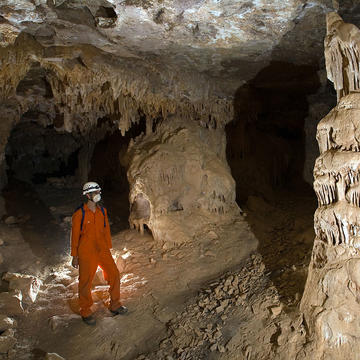
I think, fundamentally, it was wanting to better understand the environment around us, and also valuing the importance of actual measurements and real data. Models and theory are incredibly important and very interesting, but ultimately we also need robust measurements to ground our understanding of natural systems. A large part of my DPhil involved developing the “Oxford Cave”, which is a laboratory setup designed to grow carbonate crystals under carefully controlled cave-like conditions. The idea was to replicate natural cave processes as closely as possible, but in a controlled environment where we could dial into very specific environmental conditions and directly relate those conditions to the chemistry we measure in the crystals. That sort of work really appealed to me because it combines careful analytical work with understanding how environmental systems actually operate.
For people unfamiliar with it, what is stable isotope analysis and why is it so useful in Earth Sciences?
Stable isotope analysis essentially involves measuring the ratio between different isotopes of an element. For example, carbon has two main stable isotopes, carbon-12 and carbon-13. Rather than just measuring how much carbon is present, we measure the relative abundance of those isotopes, and that gives us much richer information because different environmental and biological processes preferentially incorporate different isotopes. Plants and biological systems, for example, tend to favour lighter isotopes. Those isotopic ratios therefore act a bit like fingerprints for different environmental processes. Stable isotope analysis is used across lots of fields, not just Earth Sciences. In archaeology, for example, isotopes measured in teeth or bones can tell us about diet, migration and past environments. In chemistry and medicine, isotopes can be used to understand reaction rates and biochemical processes.
What does a typical day look like running the Stable Isotope Lab?
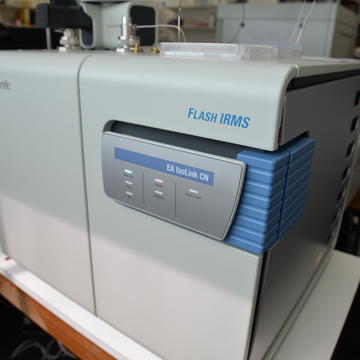
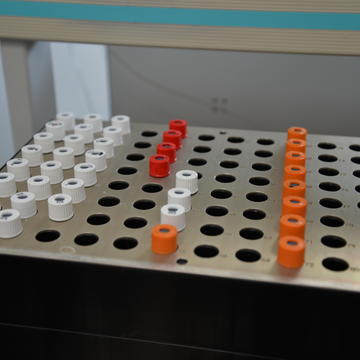
There isn’t really a typical day, which is one of the best things about the role. A lot of the work involves discussions with users about the kinds of samples they have and the questions they’re trying to answer, then designing analytical methods that are appropriate for those samples. There’s also a lot of instrument care and troubleshooting involved. Before measurements begin, we need to make sure standards are behaving correctly, vacuum systems are operating properly, there are no leaks, and that all the instruments are producing the numbers we expect. The instruments themselves are genuinely amazing. We can make isotopic measurements on sample sizes of only 10 or 15 micrograms, which is an incredibly tiny amount of material. The tubing delivering gas samples into the instrument can be as thin as a human hair. What’s particularly interesting is that the instruments are not just measuring gases, they’re also carrying out chemistry. A rock or sediment sample gets chemically converted into the gas required for the measurement, purified, and then analysed. That means there are a huge number of moving parts and many things that can potentially go wrong, so there’s a lot of detective work involved to ensure robust analytical results.
What are some of the most exciting or unusual samples you’ve worked on?
One of the more unusual examples is that some of the standards we use for archaeological measurements are actually made from mammoth teeth. Archaeologists often use standards made from different types of animal teeth or bones because they behave chemically in similar ways to the samples being analysed. So we have standards made from mammoth, bison, wildebeest and other materials. It is always interesting thinking about the past environments that these animals existed in. Beyond that, I’m especially interested in speleothems because they preserve really detailed environmental records. We can analyse them at extremely high temporal resolution and reconstruct changes in rainfall, monsoon intensity and hydrology thousands or even hundreds of thousands of years ago. A lot of my own work focuses on North Africa, seeking to understand how the Sahara changed through time and why.
Is there a particular project or collaboration that has really stayed with you?
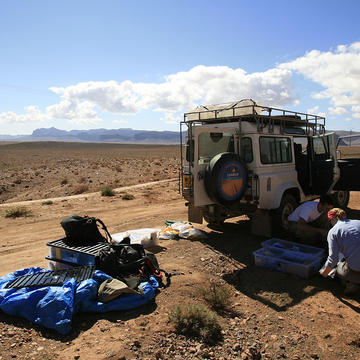
I’m particularly attached to the North African cave work. Visiting caves in northwest Africa and seeing ancient cave art depicting animals and landscapes that no longer exist there really leaves an impression. Currently those regions are extremely dry, desert environments, but at different points in the past they were greener and wetter. Standing there and imagining what those landscapes looked like, and how people lived within them, is incredibly inspiring. It motivates a lot of the research questions we work on, such as where the rainfall came from, how the climate system operated, and what those environmental changes meant for human migration and settlement. A key motivation of my group's research is to better quantify factors such as rainfall amount or soil carbon amount in past environments.
Tell us about your most memorable fieldwork experience.
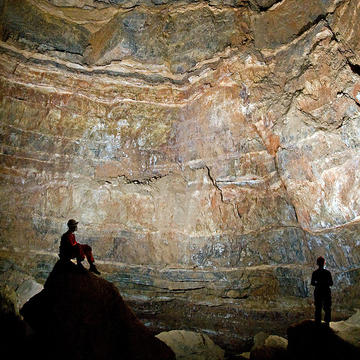
Probably visiting caves in North Africa and China. Many cave systems in the UK are beautiful, but they’re also heavily visited and modified by tourism and caving. Some of the caves we work in internationally are far more pristine. There’s also a lot of uncertainty involved in this kind of fieldwork. You travel to a region believing there may be caves there, but you don’t know whether they’ll actually contain the right kinds of samples or whether those samples will be suitable for research. So when you finally discover a cave with exactly the characteristics you need, that’s a really exciting moment.
What are some of the biggest challenges involved in maintaining highly specialised analytical equipment?
The challenge is partly the enjoyable part. I really like understanding how things work, whether that’s natural systems or analytical instruments. The less enjoyable side is when instruments stop working and you know that students or projects are waiting for data. Troubleshooting can take days or weeks, and there’s often a lot of pressure to identify the problem and fix it quickly. But there’s also a huge sense of satisfaction when the instrument is producing great results. A lot of the challenge is understanding the many interconnected components and systematically narrowing down where the issue lies.
Is there a skill you’ve developed over the years that has surprised you?
I don’t know whether there’s one specific surprising skill, but I think one thing that continually strikes me is just how broad the role actually is. It’s not simply technical work. There’s teaching involved, teaching my own students and those from diverse research groups, promoting safe laboratory practices, maintaining instruments, publishing science. That breadth is probably one of the things that makes the role enjoyable.
Have there been mentors or role models who shaped your career path?
Definitely. Even during my first undergraduate degree, which wasn’t related to Earth Sciences, there were excellent lecturers and tutors who really helped build my confidence in problem-solving and learning new things. Then during my masters and DPhil I had a number of very influential mentors, including Gideon Henderson, who provided guidance not only scientifically but also in terms of writing, defining good research questions, and learning how to tackle problems in a sensible and understandable way. I think one of the most valuable things I learned was how to identify research problems that are of wider use to the community and realistically solvable.
What’s your favourite thing about working in the Department?
One of the things I value most is the freedom to explore interesting questions. In industry, especially in IT, there was always intense pressure simply to get the job done for commercial reasons. In a university environment there’s more flexibility to properly understand how things work and to pursue questions that may not have immediate practical outcomes but ultimately become really valuable. More specifically within Earth Sciences, I love the breadth of research happening across the Department. There are always fascinating conversations happening and incredible expertise spread across so many areas. It’s a very stimulating environment to work in.
What motivates you in your work?
Honestly, I often find it difficult to stop working because I become so engrossed in whatever problem I’m trying to solve [laughs]. The problem-solving aspect is probably what motivates me most. Once I’m trying to understand something or fix something, I really want to get to the solution. That curiosity and drive to understand how things work is probably the main thing that keeps me going.
What has been the proudest moment in your career so far?
There are a couple of things that come to mind. One is helping develop calcium isotope approaches for reconstructing rainfall and hydrology from cave deposits. That work, developed here in Oxford Earth Sciences, is becoming a really useful proxy for understanding past rainfall and water availability, which obviously has huge societal importance. Another is some of the recent work we’ve done in North Africa on the sources of rainfall into the Sahara. There has been a long-running debate over whether rainfall in those regions was driven purely by expansion of the West African monsoon. Our work proposes an alternative mechanism involving tropical plumes, and it seems to reconcile quite a lot of previously conflicting observations. It feels a bit like finally getting several pieces of a jigsaw puzzle to fit together.
What advice would you give to students interested in analytical geochemistry?
I think it’s really helpful to experience laboratory work for yourself, whether through undergraduate projects, masters projects or internships. Geochemistry can involve a huge amount of careful sample preparation and analytical work, and that’s something you need to genuinely enjoy. Producing high-quality geochemical data takes significant time and effort, even before seeking to interpret and understand the results. But robust data is incredibly important for understanding the world we live in, and one that is changing at a very fast rate. I’d also encourage students to reach out to people already working in the field. That’s something I did before switching into Earth Sciences, and I was very fortunate that people were generous with their advice and guidance.
What excites you most about the future of your field?
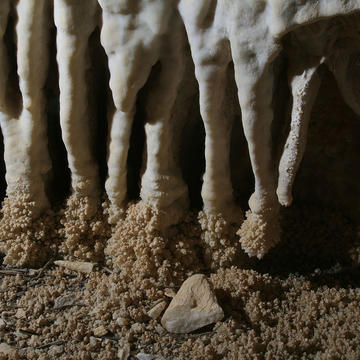
What excites me most is how much more quantitative and robust cave records are becoming. Speleothems really are extraordinary environmental archives. They can preserve information about rainfall, temperature, vegetation, soil processes and atmospheric chemistry at incredibly high resolution. Over the past couple of decades, thanks to a huge amount of effort across the geochemistry community, these records have become increasingly quantitative and increasingly reliable. It’s really exciting when you compare records from different locations and see them all telling the same climatic story. That gives us a much stronger understanding of how climate systems operated in the past and, hopefully, how they may behave in the future.
If you could design your ideal sample, what would it look like?
The slightly frustrating, but honest, answer is that ideal samples are often less scientifically interesting than difficult ones. It’s nice when a sample perfectly confirms the hypothesis you expected, but in reality the most important scientific progress usually comes when results don’t match expectations and force you to rethink your assumptions. Some of the most valuable projects I’ve worked on have taken many years precisely because the results were more complicated than we initially thought. The natural environment is almost always more complex than we expect, and while that can be frustrating, it’s also what makes the science interesting.

