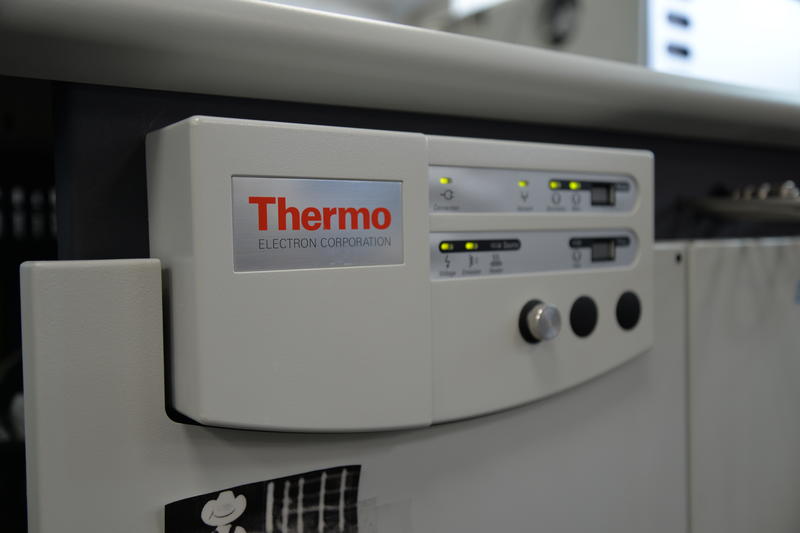
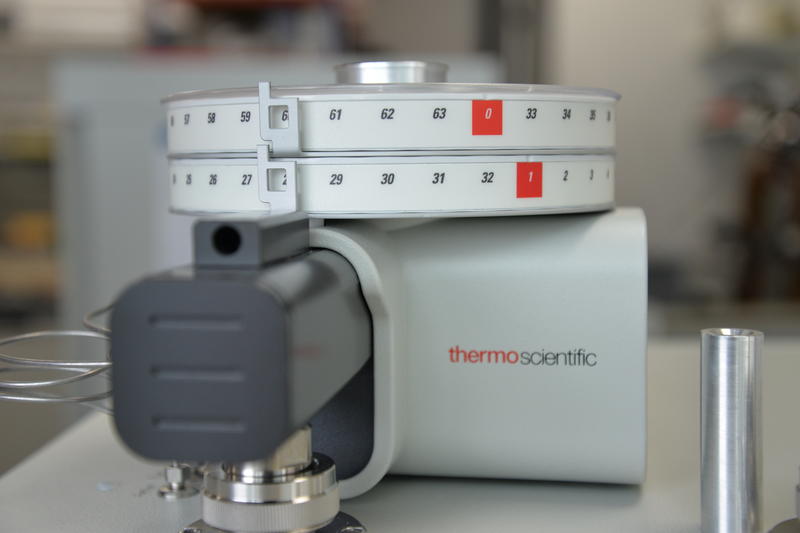
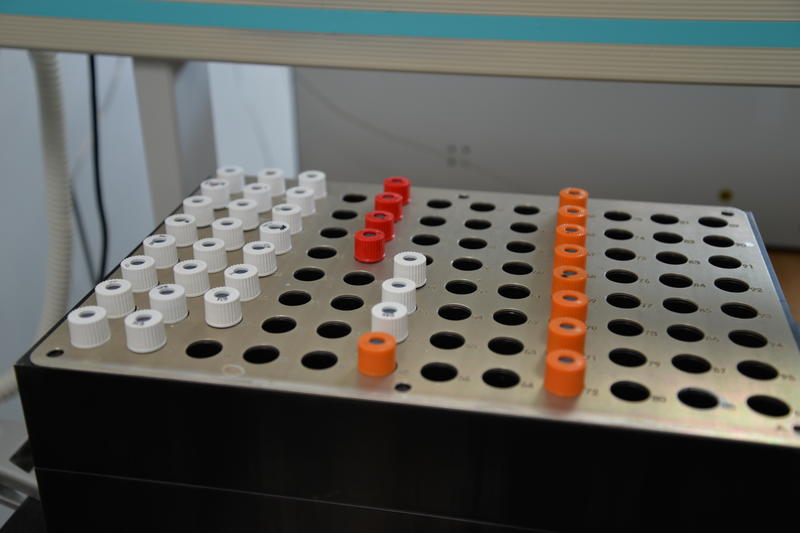
The Department of Earth Sciences Stable Isotope Laboratory provides high sensitivity analysis of a range of sample types using a Thermo DELTA V Advantage isotope ratio mass spectrometer (IRMS). All measurements are tailored to user requirements and are assessed for precision and accuracy using internationally recognised standards.
We work with users to tailor the required analyses, so please get in touch to discuss your requirements.
Capabilities
The Thermo DELTA V IRMS is coupled to a range of devices (“peripherals”) which facilitate the measurement of the following isotope systems:
- Hydrogen (2H/1H)
- Carbon (13C/12C)
- Nitrogen (15N/14N)
- Oxygen (18O/16O)
In addition, the Elemental Analyser has the capability to provide weight percentage values of both nitrogen and carbon relative to bulk, and C/N ratios.
Available peripherals are:
- Gasbench II & CTC Analytics auto-sampler for automated carbonate and solution isotopic analyses, and
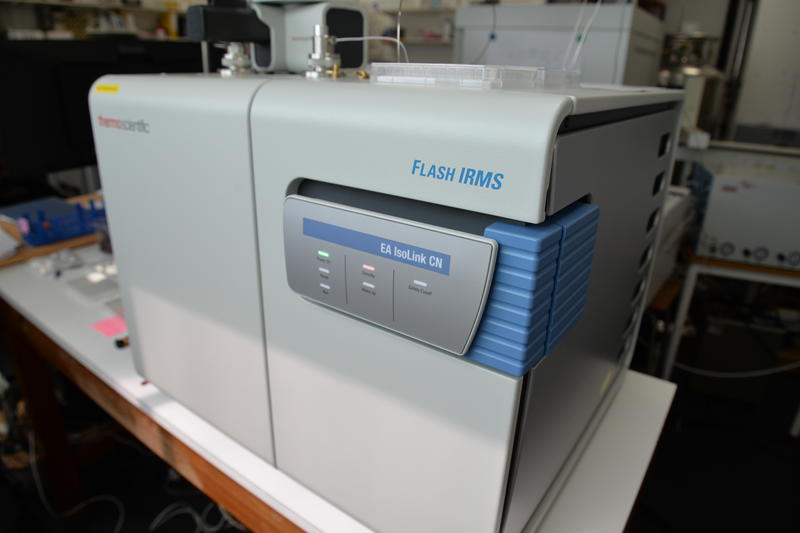
- Thermo Isolink CN Elemental Analyser and Conflo IV for C/N ratios, weight %C, weight %N, δ13C, δ15N,
- Kiel IV carbonate preparation device.
We use a Sartorius SE2 microbalance as part of weight-percent measurements, DIC concentration assessments, and for the preparation of samples for isotopic measurements.
Sample Types
Sample types include:
- Carbonates and Organic matter (from marine and terrestrial settings)
- Waters (water isotopes and Dissolved Inorganic Carbon δ13C)
- Snow and ice
- Gas
Recent projects include:
- Marine and terrestrial carbonates for palaeoclimate research
- Gas samples for understanding groundwater systems
- %C, δ18O for chemistry applications
- Stable isotopes for researching counterfeit medicines
- Tooth enamel δ13C, δ18O from rodents (palaeo-environmental reconstruction)
- Ice cores from Svalbard
- Carbon isotopes and Dissolved Inorganic Carbon concentration to assess carbon sequestration methods
Sample Requirements
The DELTA V IRMS instrument is highly sensitive, and capable of performing measurements on as little as 20 micrograms of carbonate, and 0.5 ml of water. Typically, the facility measures carbonate samples with a bulk mass of 110 – 150 micrograms, but measurement protocols are adapted to meet the needs of a myriad of sample types.
Sample measurements are calibrated using a wide range of international and in-house standards, including NBS-18, USGS40, SLAP.
Available Support
Depending on project requirements we can offer:
- Standards and calibrations
- Training on instrument use
- Full data reporting
Contact Information
For all enquiries please contact Christopher Day at chris.day@earth.ox.ac.uk.