
Earth Sciences in Conversation: Mike Kendall

Our Earth Sciences in Conversation series explores the lives and careers of members of the Department, showing readers the people behind our world-leading research. For this issue we sat down with Mike Kendall, Chair of Geophysics and Oxford EARTH Programme Director, to discuss the geophysical mysteries still hidden deep within the Earth, the role Earth Scientists will play in building a more sustainable future, and his love of electronic music...
Interview by Charlie Rex
What (or who) inspired you to go into Earth Sciences?
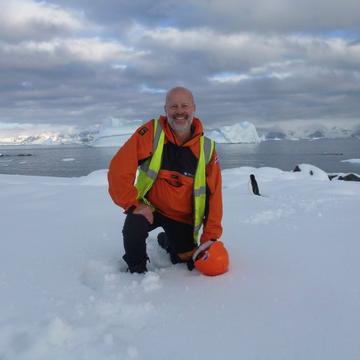
The person who first inspired me to go into science, and particularly physics, was my father, because he studied physics as well. But the person who really made me a geophysicist was actually a technician I worked with during a summer job at Chevron in Calgary. He had a degree in geophysics, and taught me the basics of seismic reflection, convolution, correlation, and how the common midpoint method works. I was just amazed that people had figured this out back in the 50s and 60s, and even more amazed at how well it worked. Once I realised I could do physics but also work outdoors and do fieldwork, I thought, “This is perfect. This is exactly what I want to do.”
Tell us about what you studied at university and your career path so far.
I started out studying physics, but in my later undergraduate years I began taking geophysics options and gradually transitioned across. After graduating, I worked for Chevron for two years before deciding I wanted to do a PhD in geophysics in the USA, but for personal reasons ended up back at my undergraduate university. A lot of my career moves, if I’m being honest, have been dictated by non-academic reasons, rather than some grand strategic plan! I was incredibly lucky because my PhD supervisor - Colin Thomson - had just arrived and I was his first student. He was a theoretical seismologist and he really shaped my research career. After my PhD, I got a Canadian NSERC fellowship and moved to the Scripps Institute of Oceanography in California to work with Peter Shearer. From there I took a temporary assistant professorship at the University of Toronto, then moved to Leeds in 1995 on what was initially a university research fellowship that became a permanent position. I thought I’d stay here for two or three years maximum, but I ended up remaining in the UK. In 2005 I moved to Bristol, where I eventually became Head of Department, and then in 2019 I moved to Oxford.
What are the big questions that drive your research?
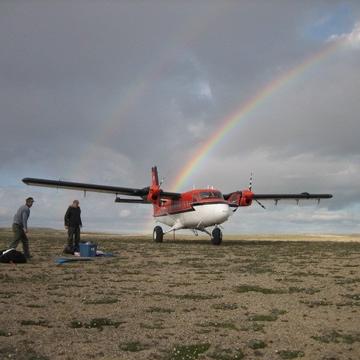
The questions driving my research have changed throughout my career. Early on, I was fascinated by how seismic waves propagate through complex materials. It was very technical and phenomenological. Then I became much more interested in how the Earth works on a large scale, looking at things like the core-mantle boundary, subduction zones and mid-ocean ridges. Later, I started working in Africa and became fascinated by continental rifting, particularly in East Africa. Rifting is such a fundamental part of plate tectonics, but we didn’t really understand what was driving it. Through collaborations with fantastic colleagues, postdocs and students, we eventually showed that the mantle beneath Africa is actually playing a major role in driving the rifting process. While doing that work, I became increasingly interested in volcanoes and the surface expression of rifting. At the same time, I was also working on geological storage of CO2, which pushed me more towards applied geophysics. Once I realised how strongly volcanoes are linked to geothermal energy and critical metals, that really became a major focus. A lot of my work now sits at the intersection between fundamental Earth processes and societal applications.
Tell us about a major geophysics problem that still puzzles researchers.
One of the really big unanswered questions is still the nature of mantle convection and what exactly is happening at the core-mantle boundary. Those questions have been around for decades, and while we’ve learned a huge amount, there’s still a lot we don’t understand. The structures at the core-mantle boundary are actually larger and more dramatic than the structures on the surface of the Earth, and we still don’t really know what they are compositionally. They also influence all sorts of other processes, including the Earth’s magnetic field, so they’re incredibly important.
Are there still discoveries in Earth Sciences that could fundamentally change our understanding of the planet?
Definitely. That’s one of the reasons Earth Sciences is such an exciting subject. You can make genuinely significant discoveries surprisingly quickly, even early in your career. One area that’s really exciting right now is critical metals. We’ve known for a long time that many critical metals are associated with volcanic systems, but we still don’t fully know how to locate them accurately. It’s a bit like finding a needle in a haystack. What’s changing now is that we’re getting much better at imaging the subsurface and using machine learning and integrated geophysical approaches to identify where these resources are likely to be concentrated. If we can combine that with geothermal energy and greener extraction technologies, that becomes a real societal game changer.
What’s the most exciting technological advance you’ve seen in geophysics during your career?
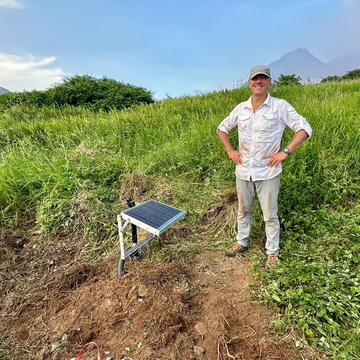
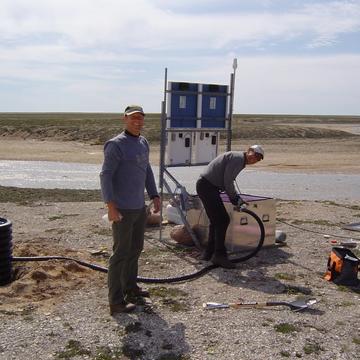
Right now, I’d say instrumentation. We now have these tiny seismic sensors that are incredibly cheap, run on lithium batteries, and contain GPS systems. We can deploy hundreds, or even thousands, of them very rapidly, whereas older seismometers were huge, expensive, and took hours to install. At the same time, fibre optic cables are becoming extraordinary seismic sensors. You can detect earthquakes, landslides, ocean waves, and even distinguish between different species of whales, all through laser interrogation of fibre optic cables. That’s generating enormous quantities of data, and because computational methods and machine learning have advanced so rapidly, we can now process and analyse that information incredibly efficiently. It’s a genuinely exciting time for geophysics.
Tell us about your most memorable fieldwork experience.
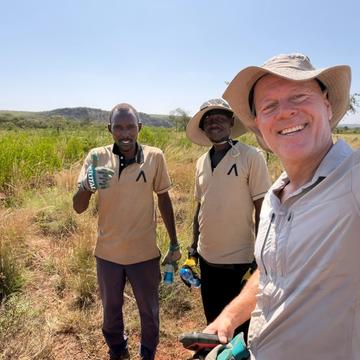
Probably Ethiopia. It’s an extraordinary country geologically and culturally. The landscape is stunning because you go from mountains more than four kilometres high down into regions below sea level over very short distances. One of the highlights was climbing Erta Ale volcano at night to see the active lava lake. We had a seismometer deployed nearby, which conveniently gave us an excuse to go up and have a look [laughs]. Seeing an active lava lake in person is just incredible. Ethiopia is also a fantastic place to work because the people are all wonderful. It’s one of my favourite fieldwork locations.
What’s the most unexpected opportunity your career has given you?
Probably moving to Leeds. I was sitting in my office in Toronto when David Gubbins phoned me and asked if I’d consider applying for a job there. At the time, all I really knew about Leeds was that The Who had an album called Live at Leeds, and that they once had a decent football team. But I took the risk, moved over, and it completely changed the trajectory of my career. I honestly don’t think I would have had the same career if I’d stayed in Canada, which is sad as a Canadian [laughs].
What keeps you excited about Earth Sciences after so many years in the field?
What excites me now is that Earth Sciences sits right at the centre of some of the biggest societal challenges we face. For a while, climate and environmental discussions were very pessimistic, focused mainly on describing how bad things were becoming. But now there’s a much stronger focus on solutions, and Earth Sciences is central to those. Whether it’s critical metals, geothermal energy, carbon storage or sustainable resource extraction, Earth Scientists have a huge role to play. It’s especially exciting teaching students about this because there are so many different ways they can contribute.
What has been the proudest moment in your career so far?
I’ve been incredibly lucky to work with so many exceptional students and postdocs. I’m probably proudest of the careers they’ve gone on to have and the fact that I’ve hopefully helped support people from a wide range of backgrounds. Being elected to the Royal Society was also obviously a huge honour and something I was absolutely thrilled about.
What are you most proud of from your time leading Departments in Bristol and Oxford?
In Bristol, one of the things I’m most proud of is how much we improved gender balance within the Department. When I became Head of Department, the balance at senior levels was really poor. By the time I left, we had recruited a large number of outstanding women and significantly improved representation across the Department. In Oxford, the biggest challenge has probably been financial sustainability. The Department’s deficit was growing rapidly, and we had to tackle that directly. It wasn’t glamorous work, but I think we did a good job stabilising things financially.
What are some of the best parts of being a Head of Department?
One of the nicest things is that you get to celebrate everyone else’s successes. When someone wins a big grant, publishes a major paper, or gets promoted, you genuinely feel proud because you know how much work has gone into it. You also get this much broader view of everything happening across the Department, and it’s constantly impressive. Departments like Bristol and Oxford are genuinely world-leading places, and it’s very rewarding being part of that.
What have you learned about leadership during your career?
One of the biggest lessons is that you can’t please everybody. Another important thing I’ve learned is that difficult problems are almost always easier to deal with early rather than kicking them down the road. I’ve had to deal with some really difficult situations over the years, and while those conversations are uncomfortable, delaying them only makes things harder. Leadership also really improved my confidence because standing up and speaking to your peers as the person supposedly leading them can actually be surprisingly intimidating.
What makes a great research culture?
I think good research culture comes down to making people feel supported and part of a team. One thing I always tell PhD students is not to compare themselves too closely to others because everyone progresses at different rates. Some people publish very quickly, while others take much longer, and neither approach is inherently better. I also think it’s important to build research groups that function more like pyramids than houses of cards. Senior postdocs help support junior postdocs and students, and people help each other out rather than competing destructively. Ultimately, the best research environments are built around mutual respect, patience, collaboration, and recognising that people learn in different ways.
What’s your vision and ambition for the Oxford EARTH programme?
Oxford EARTH is fundamentally about equitable and sustainable access to resources. That means everything from discovering resources and developing greener extraction technologies to understanding the environmental and societal impacts of mining. The vision is that within five years Oxford EARTH becomes a world-leading, self-sustaining research centre tackling these questions in a genuinely interdisciplinary way. What’s exciting about Oxford is that you can bring together experts from Earth Sciences, engineering, geography, law, policy, chemistry and many other areas. The challenge is getting everyone speaking the same language, but the opportunity is enormous.
What role should Earth Scientists play in the transition to a more sustainable future?
Earth Scientists are absolutely central to it. We need enormous quantities of materials for the energy transition, and we need to find and extract them responsibly. We’ll need more copper in the next 25 years than humanity has ever consumed before. Earth Sciences is fundamental to understanding where those resources are, how to extract them more sustainably, and how to minimise environmental damage while doing so.
How optimistic are you about our ability to solve major Earth and climate challenges?
I’m actually very optimistic. Humans are incredibly good at problem-solving when we need to be. There’s enough subsurface capacity to sequester the CO2 we emit, and technologically we already know how to do many of the things we need to do. There’s still a lot of work required, and we need the right policies and societal will, but I genuinely think these problems are solvable. I’m not someone who believes we should just throw our hands up and give up.
Looking back, what advice would you give your younger self?
I probably would have told myself not to take myself quite so seriously. Scientifically, I also wish I’d worked with real data much earlier. My PhD was completely theoretical, and while that taught me a lot, you eventually realise that real Earth data are much messier than theory, and that I shouldn’t have been stressing about the tiniest little problems. I also wish I’d learned a bit more geology earlier on because there are still mineral names that completely defeat me.
If you weren’t an Earth Scientist, what do you think you’d be doing instead?
A friend and I used to joke that we’d open a café together that served good homemade food and played really good music. I’ve also always been fascinated by electronic music, so maybe something in that world [laughs]. But honestly, I feel very lucky because once I discovered geophysics during that summer job, I never really looked back.
What’s something about the Earth that still fills you with wonder?
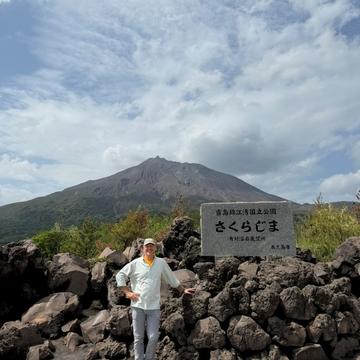
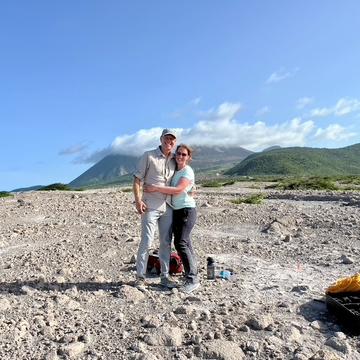
Volcanoes, definitely. I was recently in Japan and took the ferry every day past Sakurajima, one of the most active volcanoes in the world. Shortly after I arrived, it erupted. Seeing something like that in person just fills you with awe because it’s this tiny surface expression of the incredible dynamism happening inside the Earth. Mountains, volcanoes, tectonics – they still make me stop and think how extraordinary this planet really is.
Finally, what’s your favourite piece of fiction that involves Earth Sciences?
There’s a fantastic Prince Buster ska song called Earthquake, and Brian Eno has a brilliant piece called Lava. Film-wise, The Core is scientifically ridiculous but very entertaining. I also really like Haruki Murakami’s short stories inspired by the Kobe earthquake. They’re not directly about the earthquake itself, but they explore the emotional and philosophical aftermath of living in a place shaped by these huge natural forces. There’s something very Japanese about that relationship with natural hazards, where they’re simultaneously feared and embraced as part of life.

