


Falling Sea Levels Helped Remove Carbon from Earth’s Atmosphere Over Millions of Years
A new study by researchers from the Oceanbug research group at Oxford Earth Sciences has revealed that changing sea levels in the past boosted marine productivity and helped enhance carbon burial in the oceans over millions of years. In collaboration with scientists at Syracuse University and the University of Copenhagen, they have uncovered a previously overlooked mechanism that may have helped drive Earth’s transition from a warm “greenhouse” world to the cooler “icehouse” climate state of the recent geological past. The study was published today in the journal PNAS.
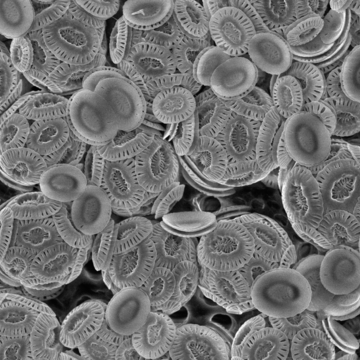
Coccolithophores are microscopic ocean-dwelling organisms that play a crucial role in organic carbon production and burial. Image credit: Dr Alison Taylor
The new study, which reconstructs changes in ocean nutrient cycles over the past 60 million years, suggests that falling sea levels increased the amount of phosphate available in the open ocean. This stimulated marine productivity and enhanced the burial of organic carbon in seafloor sediments, helping to lock atmospheric CO2 away over geological timescales.
The findings provide a potential explanation for one of Earth science’s long-standing mysteries: where the vast amounts of atmospheric CO2 associated with our former global greenhouse ultimately went as the planet cooled.
The researchers used a newly compiled global dataset, together with carbon isotope mass balance calculations, to reconstruct long-term changes in organic carbon burial. Their analyses indicate that rates of organic carbon burial generally increased towards the present.
“We know that atmospheric carbon dioxide decreased substantially as Earth cooled over the last 60 million years, but we have had remarkably little understanding of where that carbon ended up. Our results suggest that enhanced burial of organic carbon in marine sediments played a much more important role than was previously appreciated.”
- Professor Ros Rickaby, lead author of the study
Crucially, the study identifies phosphate (an essential nutrient for marine life) as a key missing piece in the puzzle. Phosphate has previously been an “invisible nutrient” in the eyes of geologists, but its availability can now be determined indirectly from the coupled record of organic carbon burial and water column oxygen.
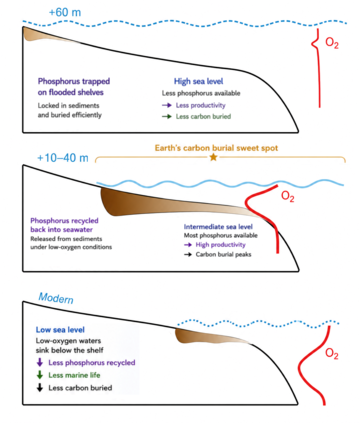
Phosphate enters the ocean through the weathering and dissolution of rocks on land. However, whether this nutrient becomes available to sustain life in the open ocean depends on its fate once it reaches the coast. According to the researchers, this is strongly controlled by sea level.
During periods of high sea level, extensive continental shelf areas become flooded. These regions accumulate sediment rapidly, making them highly efficient at trapping and burying phosphate before it can reach the open ocean. As a result, marine ecosystems become comparatively nutrient-starved. But when sea levels fall, the area of these efficient phosphate “traps” shrinks dramatically.
“This effect is similar to the ring of grime left behind as water drains from a bathtub,” said Professor Rickaby. “As sea level falls, the zone where phosphate is efficiently buried shifts downslope and occupies a much smaller area. This allows a greater proportion of phosphate to escape into the open ocean, where it fuels increased biological productivity.”
The increase in productivity associated with greater phosphate delivery to the oceans ultimately leads to greater burial of organic carbon in sediments, as ocean life is able to thrive. Over geological timescales, this removes carbon dioxide from the atmosphere, cooling the climate.
The study also reveals how this nutrient-driven increase in marine productivity affected ocean oxygen levels. As more organic matter sank into the deep ocean and decomposed, oxygen was consumed from seawater, leading to the expansion of oxygen minimum zones – regions where oxygen concentrations are extremely low. The researchers identified geochemical evidence suggesting that these oxygen-poor conditions became more widespread as sea levels declined. This would have reduced phosphate burial rates further, amplifying the amount of phosphate available to sustain life and creating an amplifying feedback for glaciation.
Once set in motion though, this cooling feedback could in principle run away towards a globally-glaciated “Snowball Earth”. The final twist in the tale is that as the oxygen minimum zones deepened alongside falling sea levels, they became increasingly separated from phosphate-rich continental shelves, slowing phosphate recycling back into the ocean.
The work reinvigorates the idea that phosphate availability changes systematically with sea level and acts as a major feedback on Earth’s long-term carbon cycle. It finds a “sweet spot” of organic carbon burial at intermediate sea levels, challenging several long-standing assumptions about the links between climate, ocean chemistry, and marine ecosystems.
“The Earth’s carbon cycle is closely tied to the way nutrients move through the oceans, but reconstructing those movements through time is extremely challenging. By combining two very different geological records – iodine/calcium measurements that track oxygen conditions in the ocean, and alkenone carbon isotopes that record changes in organic carbon burial – we were able to uncover a new link between falling sea levels, marine productivity, and long-term climate cooling. What is especially exciting is that bringing these datasets together revealed a delicate balance in the carbon cycle that had been largely invisible before, helping explain how the Earth gradually shifted from a greenhouse world into an icehouse climate over millions of years without spiralling into a Snowball.”
– Tom Wood, co-author of the study
The study “Shelf-invading low-oxygen waters control Cenozoic organic carbon burial rates” is available to read in PNAS at https://doi.org/10.1073/pnas.2526409123.

