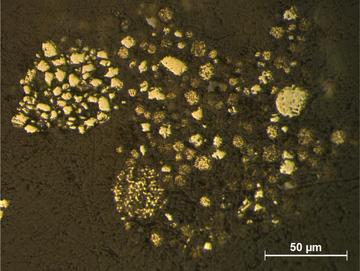
Stable sulfur isotopic data (e.g., d34S) provide a framework for understanding microbial metabolic activity today and for reconstructing both ecological and environmental change over Earth history. These reconstructions often rely on bulk sediment measurements and the assumption that the values measured in a given sample are representative of the relevant microbial activity and biogeochemical processes under investigation. Here we demonstrate that this is frequently not the case for sedimentary pyrite samples, one of the most common proxies that we have for reconstructing past S cycling microbial activity. Micro-scale isotopic analyses of individual pyrite grains show that typical bulk sedimentary values integrate multiple distinct phases of microbial activity with clearly distinguishable isotopic signatures. Building upon a collection of modern/Pleistocene-aged samples, we provide a framework to extract relevant microbial fractionation during both organoclastic sulfate reduction and anaerobic oxidation of methane coupled to sulfate reduction, as well as key environmental variables such as sedimentation rate and ambient sea level. This approach can be used to extract ecological and environmental meaning from the long-term trends in d34S signatures over Earth history.
Venue
Seminar rooms
If you are external to the Department of Earth Sciences and wish to receive information about departmental seminars please join our mailing list by sending a message to: earth_sciences_seminar-request@maillist.ox.ac.uk