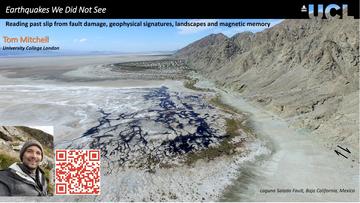
Most earthquakes, landslides and rapid slip events are never observed directly. What remains is an incomplete and often overprinted archive: fractured fault rocks, low-velocity zones, altered permeability, displaced landscapes, frictional melts, magnetic fabrics and signals that may have partly healed or been erased. This talk asks how we can read that archive to reconstruct past dynamic slip.
I will explore how high-resolution field mapping, laboratory rock deformation, geophysical imaging, planetary geomorphology and emerging magnetic methods can be combined to distinguish rapid coseismic processes from slower, quasi-static fault growth. Fault damage zones preserve information about rupture, energy dissipation and fluid flow, but their present-day structure also reflects healing, sealing and long-term overprinting. Landslide deposits provide a complementary record of rapid granular failure, where morphology and fabric can be used to infer flow processes after the event. A new frontier is the possibility that magnetic minerals preserve stress signals even where rocks did not visibly fracture, offering a potential way to image the missing elastic stress field around past ruptures.
The broader aim is to ask what rocks and landscapes can genuinely tell us about earthquakes we did not see: how fast they slipped, how large they were, where the energy went, and how much of the original signal survives.
Venue
Seminar rooms
If you are external to the Department of Earth Sciences and wish to receive information about departmental seminars please join our mailing list by sending a message to: earth_sciences_seminar-request@maillist.ox.ac.uk