


Tiny ocean plankton reveal hidden controls on Earth’s carbon cycle
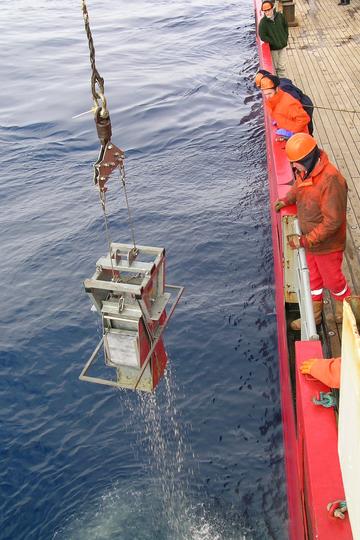
A box corer was used to collect samples of surface sediments containing coccolithophores for this study. Image credit: Ros Rickaby
Scientists have uncovered how tiny marine plankton regulate the production of calcite in the ocean – a process that plays a major role in Earth’s long-term carbon cycle and climate regulation. The study, led by researchers at Oxford Earth Sciences, analysed fossil remains of recent coccolithophores preserved in Atlantic Ocean sediments to reconstruct how different species respond to changing environmental conditions. The findings were published today in Nature Communications.
Coccolithophores are microscopic phytoplankton that surround themselves with calcite plates known as coccoliths. These organisms produce a large proportion of the ocean’s calcite and help transport carbon from the surface ocean to deep-sea sediments, influencing atmospheric CO2 over geological timescales.
Despite their importance, scientists have struggled to understand how environmental conditions control calcite production in natural ocean settings. Previous laboratory experiments provided important clues, but translating those results to real marine ecosystems and the geological record has remained challenging.
To tackle this problem, the Oxford-led team developed a new framework for reconstructing coccolithophore physiology directly from sediments. The researchers examined well-preserved coccoliths from surface sediments collected along a north-south transect across the Atlantic Ocean, spanning environments from subpolar to tropical waters. Using microscope-based techniques, they measured coccolith abundance, size, thickness and mass to infer growth rates, calcification intensity and calcite production in different coccolithophore groups.
The study revealed striking differences between groups of coccolithophores with contrasting calcification strategies. Smaller, fast-growing species produced the most intensely calcified coccoliths when environmental conditions – including temperature, light and nutrient availability – were optimal for growth. In contrast, larger and more heavily calcified species became less intensely calcified when they reached peak abundance.
This reflects a fundamental physiological trade-off between cellular demand for carbon and the environmental supply of carbon available for calcification. For smaller cells, carbon supply in the modern ocean appears sufficient to keep pace with rapid growth and calcification. But in larger cells, demand for carbon can outstrip supply when growth rates are high, limiting how much calcite those organisms can produce.
The team also discovered a major geographical divide in calcite production across the Atlantic Ocean, centred around 40°N latitude. North of this boundary, larger heavily calcified species dominate calcite production, while south of it, smaller fast-growing species prevail.
This boundary aligns closely with large-scale environmental gradients in ocean temperature, nutrient availability and seawater carbon chemistry. The researchers suggest it marks a transition between two different modes of calcification: one limited mainly by chemical reaction rates and another limited by the transport of carbon into cells.
Lead author Alba Gonzalez-Lanchas said: “What makes this work unique is that it is based on the application of relatively traditional and widely used microscope-based micropalaeontological and morphometric techniques within the calcareous nannoplankton community.”
She added: “We uncover specifically how the environment modulates physiology to control the calcification intensity of cells and how that leads to higher or lower calcite production.”
The new framework could help scientists better interpret ancient climate records preserved in marine sediments, allowing them to reconstruct how coccolithophores responded to past changes in ocean chemistry and atmospheric CO2.
Professor Ros Rickaby, co-author of the study, said: “With these tools we propose a new framework for the reconstruction of coccolithophore physiology from sedimentary records that may help approaching past geological intervals in future research.”
The findings may also have implications for understanding how marine calcifiers will respond to future climate change. As ocean temperatures rise and seawater chemistry changes due to increasing atmospheric CO2, the balance between carbon supply and cellular demand could shift, potentially altering which coccolithophore groups dominate future oceans.
The study “Atlantic sediments reveal interacting environmental and physiological controls on coccolithophore calcite production” is available to read in Nature Communications at doi.org/10.1038/s41467-026-73162-5.

