


SLAMS-2.0: following marine particles to understand ocean carbon storage
Dr Anna Rufas and her co-authors developed SLAMS-2.0, a model that follows tiny biogenic particles as they carry carbon from the surface ocean to the deep sea. The study, a decade in the making, was published in the Journal of Advances in Modeling Earth Systems (JAMES) last week.
Small biogenic particles – which may start as plankton cells or mineral material, for example – sink through the ocean, taking with them huge quantities of carbon. While almost invisible individually, together they form a “biological carbon pump” that helps the ocean absorb carbon dioxide from the atmosphere and so regulates Earth’s climate. However, oceanographers cannot reliably predict how efficiently particles deliver carbon to depth, what controls this, or – crucially – how it will change as the climate changes. Current climate models describe how quickly particulate organic carbon is lost with depth, but not why.
SLAMS-2.0 (Stochastic, Lagrangian Aggregate Model of Sinking particles, version 2.0) follows marine particles through their life histories as they form, transform, and sink. Where many models treat organic particles as bulk concentrations, SLAMS-2.0 tracks them individually, revealing how their properties and chance encounters shape carbon’s journey downward.
The approach borrows the Lagrangian viewpoint physical oceanographers use to follow water parcels, but with a twist: unlike a parcel of water, a marine particle doesn’t keep its identity. It sinks through the water rather than moving with it, and changes along the way:
• it can stick to others – glued by sticky gels exuded by phytoplankton – or break apart
• it can be eaten by zooplankton and repackaged into faecal pellets
• it can be broken down by microbes, although minerals inside a particle can partly shield its organic matter from attack
• it can lose minerals as these dissolve
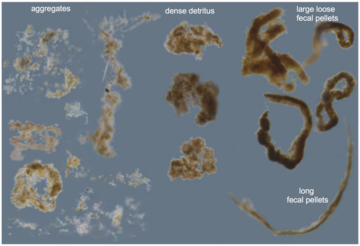
The model assigns each event a probability based on established biogeochemical rules, so a particle’s fate depends on its composition and microstructure, its surroundings, and chance.
To make this computationally manageable, each simulated “superparticle” represents a group of identical real particles. It is a trick borrowed from cloud physics, where it is used to simulate how raindrops grow by colliding and merging. This lets the model represent vast numbers of particles while still tracking their composition, structure and sinking behaviour.
Dr Rufas tested the model at six contrasting ocean sites, from nutrient-poor subtropical waters to polar seas, against flux measurements, particle abundances and size distributions, including in situ and satellite-derived data.
“After ten years developing SLAMS-2.0, I’m excited to see how other researchers will use it. By following particles through their individual lives, it gives us a new lens on how the ocean moves carbon into the deep sea. It’s also a flexible testbed for designing field campaigns and, ultimately, for improving climate models.” - Lead author, Dr Anna Rufas.
The simulations suggest that how carbon is packaged matters more than particle size alone. Bigger particles do not necessarily sink faster: as they grow by clumping together, they become more porous, gaining bulk without gaining much weight. Large, porous, carbon-rich clumps containing heavy minerals can carry a disproportionate share of carbon to the deep ocean because they are more likely to survive the journey. Sinking speed affects when carbon arrives, while a particle’s makeup decides how much arrives.
While the team emphasise that SLAMS-2.0 is a research tool rather than a definitive model, it can now act as a “virtual laboratory”, allowing researchers to switch biological carbon pump processes on or off to see what controls particle-mediated carbon storage, helping them to decide which oceanographic measurements to prioritise next for studying the ocean carbon cycle.
Next, the team will place SLAMS-2.0’s particles in a moving ocean, using the Transport Matrix Method developed by co-author Samar Khatiwala, so that currents and mixing carry them as well as gravity. The model also treats microbial breakdown simply for now; representing the microbial communities that colonise particles is a natural way forward.
The paper “SLAMS-2.0: A Stochastic, Lagrangian Particle-Resolving Modeling Framework for Investigating the Biological Carbon Pump” is available to read in the Journal of Advances in Modeling Earth Systems (JAMES) at https://doi.org/10.1029/2026MS005869.

