


How The Euphrates River Was Born
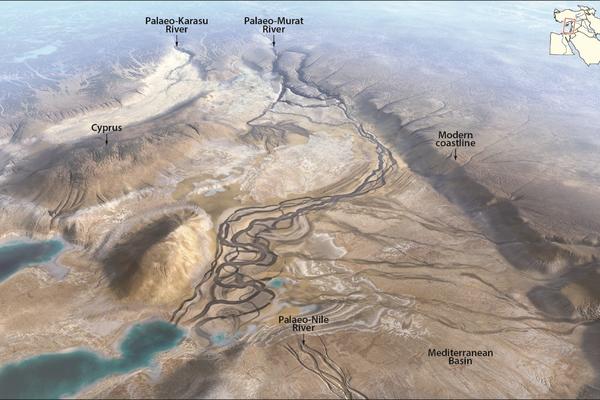
Aerial view of the eastern Mediterranean around 5.5 million years ago. Image credit: Lina Jakaitė and Andrew S. Madof
New research has shown that the Euphrates River, one of the most historically significant river systems in Western Asia, originated as two distinct river systems that drained into the Mediterranean approximately 5.5 million years ago. In a new paper published today in Nature Geosciences, an international team of researchers, including Claudia Bertoni and Richard Walker, investigated the role these waterways had in delivering freshwater to the Mediterranean during the “Messinian Salinity Crisis”, and how tectonic activity redirected their course towards the Persian Gulf.
The Euphrates River was a defining lifeline of early civilization, shaping Mesopotamia and the ancient cities of Babylon, Mari and Nippur. Now the longest river in Western Asia, it is a major regional waterway which flows through Turkey, Syria and Iraq. The river currently enters the ocean in the Persian Gulf, but new evidence suggests that it originally flowed into the Eastern Mediterranean – and did so during a critical period of the region’s geological history.
5.5 million years ago, the Mediterranean was experiencing ‘the Messinian Salinity Crisis’, a period when vast amounts of salt, often kilometres in thickness, was deposited across the sea floor. Producing this amount of salt requires mass evaporation of sea water, though there has been a long-lasting debate about whether this was caused by a large-scale fall in sea-level, or whether evaporation was balanced by periodic inflows of new water.
Earlier work confirmed the former; a discovery of sediments (the Handere and Nahr Menashe deposits) on top of the Messinian salt deposits indicate that a river system existed at this time, suggesting that sea level dropped by around a kilometer, leaving much of the Mediterranean Sea of today a dried-out salty desert. But a further mystery remained, because no large rivers flow through the area today – so which river transported these sediments through the dried-out Mediterranean?
A new study, led by USA-based researcher Andrew Madof and featuring Claudia Bertoni and Richard Walker, has used seismic‑reflection data, geomorphic mapping, and sediment‑budget modelling to link the origin of these sediments to the Palaeo-Karasu and Palaeo-Murat rivers. These ancient river systems flowed from Anatolia to the eastern Mediterranean at the end of the Messinian salinity crisis, delivering vast volumes of water and sediment into the basin and forming the offshore geology seen today.
“The findings offer new insight into how large river systems respond to coupled changes in tectonics, base level, and climate, and how these processes shaped the physical landscape that later supported early human civilizations.”
- Claudia Bertoni, co-author of the study
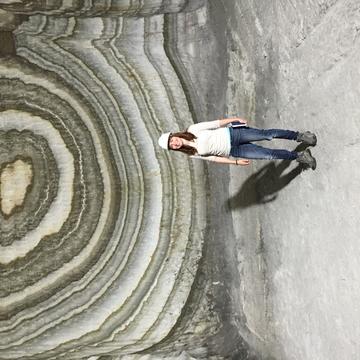
Co-author Claudia Bertoni in a Salt Mine in Sicily
The team also found that around five million years ago, tectonic activity reshaped the landscape, causing the downstream parts of the two river systems to be shifted away from the Mediterranean and to coalesce in what we now see as the Euphrates River, which flows through to the Persian Gulf. The ancestral Euphrates flowed within only a few tens of kilometres of the Nile, and discharged higher volumes of discharged sediments into the sea. The results provide valuable constraints on eastern Mediterranean geography during a period of pronounced environmental change.
“This study shows the key role of tectonics in the development of the Fertile Crescent”, said study co-author Professor Richard Walker. “The Fertile Crescent is the name given to the broad swathe of land in which farming and complex societies first arose, and it relies on the major Euphrates and Tigris river that flow through its centre. Without the reorganization of the Euphrates river course and its diversion from the Mediterranean to the Persian Gulf, the environment of the region, and so a large part of our history, might have been very different”.
The study “Late Miocene Euphrates River drained into a partially desiccated eastern Mediterranean” is available to read in Nature Geoscience at doi.org/10.1038/s41561-026-01962-x.

