


Earth Sciences in Conversation: Isabel Smith

Our Earth Sciences in Conversation series explores the lives and careers of members of the Department, showing readers the people behind our world-leading research. For this issue we sat down with Isabel Smith, Postdoctoral Research Assistant, to hear about storm chasing in Oklahoma, how volcanic eruptions shape our climate system, and why turbulence is becoming an increasingly important challenge for aviation.
Interview by Charlie Rex
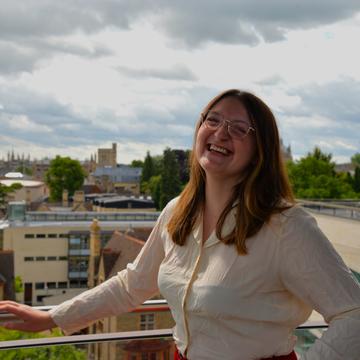
What (or who) inspired you to go into Earth Sciences?
When I was about one my parents moved to Hong Kong, so growing up I experienced intense rainfalls and typhoons. I remember my parents having to tape the windows because the wind was making the glass panes move, and as a child I just thought, “This is so cool. What on Earth is going on outside?” and I wanted to learn more about it. As I got older, I loved maths and physics, but I also loved the outdoors and geography. Then I discovered the Meteorology and Climate course at the University of Reading, and that was really the start of it all. I originally went into meteorology and then later branched into volcanology and other areas, but that’s where my fascination with Earth Sciences began.
Tell us about what you studied at university and your career path so far.
I studied an integrated master’s degree in Meteorology and Climate at the University of Reading, which included a year abroad at the National Weather Center in Oklahoma. It was incredible because we’d spend the morning learning about severe weather in the classroom, like hailstorms and tornadoes, and then in the afternoon we’d actually go storm chasing. I still remember my mum messaging me asking if I was safe because she’d seen there was a tornado in Oklahoma, while I was literally chasing it. That was definitely a highlight of my degree. After my undergraduate, I stayed in Reading for my PhD before moving to the University of Exeter for a postdoc, which then led me to Oxford.
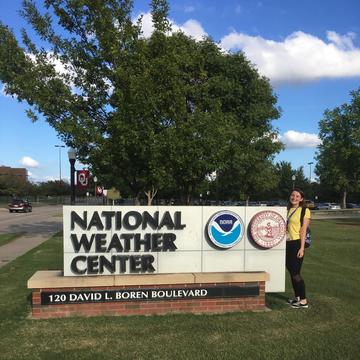
Outside the National Weather Center
Wait, so like Twisters?
Yes – there is a photo of Glen Powell and Daisy Edgar Jones in the same classrooms as I studied in when they went there to learn about the weather before filming! One of the girls from my class wrote some of the equations for one of the scenes – that’s a cool flex for her and cool flex for me via her [laughs].
Was there a particular moment when you decided to pursue academia as a career?
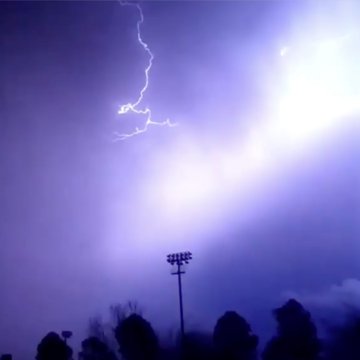
In the final year of my undergraduate degree, I did a dissertation looking at whether lightning strikes might become more intense with climate change. We already know lightning is projected to become more frequent, but I was looking specifically at changes in current intensity. The project used quite a small case study, so the results were fairly inconclusive, but I still remember the feeling of getting a result and realising I was looking at something that nobody had studied before. It was incredibly exciting. I realised I wanted to keep researching and be part of this global community of people trying to better understand the world and contribute to a better future. Does that sound cliché?
Not at all! What first fascinated you about the atmosphere and weather systems?
Growing up my family would often do long drives between Scotland and England, and I spent a lot of time staring out of the car window looking at clouds. You’d see these huge cumulus clouds building up and changing shape, and when you’re young you make stories out of them and imagine different figures in the sky. Then as I got older, I started wondering why clouds formed the way they did and why the atmosphere looked so different from one day to the next. That curiosity about what was happening in the sky was a big part of what drew me into meteorology.
What are the big questions that drive your current research?
My research focuses on volcanoes and climate. When a large volcanic eruption injects sulphur dioxide high enough into the atmosphere, it reaches the stratosphere and oxidises into sulphate aerosols. Those aerosols are transported around the globe and form a layer that scatters incoming solar radiation, which leads to global cooling and changes in precipitation patterns. My work is trying to understand the best way to represent volcanic forcing in climate models. At the moment, many models prescribe aerosol properties directly, whereas another approach is to inject the sulphur dioxide interactively and allow the chemistry to happen within the model itself. I’m interested in comparing these approaches and improving how volcanic forcing is represented in future climate projections.
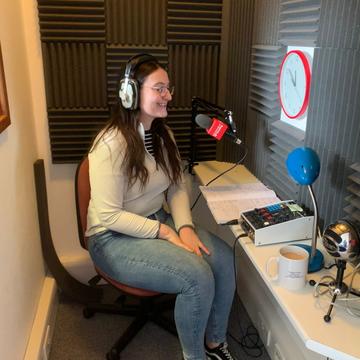
During a media interview about clear air turbulence
Why is it important to represent volcanic forcing accurately in climate models?
Volcanic forcing has a huge impact on climate and is one of the largest natural forcings on the atmosphere. If we can better understand how volcanic eruptions affected the climate in the past, we can improve the accuracy of future climate projections. Having a realistic representation of volcanic cooling is really important for understanding long-term climate behaviour and improving predictions of future climate change.
Your PhD research was about turbulence. Why is understanding atmospheric turbulence important, particularly for aviation?
My PhD focused on clear-air turbulence, which develops around jet streams. There are four main types of upper level atmospheric turbulence, but clear air turbulence is my baby! Jet streams are these fast-moving bands of wind that circle the globe, and because the wind speeds change rapidly around their edges, you get wind shear that can break down into chaotic turbulent flow. This is the type of turbulence aircraft often encounter when flying over the North Atlantic. Observations show that clear-air turbulence has increased significantly since 1979, and my research looked at future projections using climate models. I found that turbulence patches are likely to become more frequent, larger, and wider across the North Atlantic. That has important implications for aviation because aircraft may need to take longer diversions to avoid these turbulent regions, which increases fuel use and costs. For passengers, it probably means more light and moderate turbulence during flights rather than dramatically increased danger. Severe turbulence remains very rare, and forecasting is generally very good, but understanding these trends is important for aviation safety and planning.
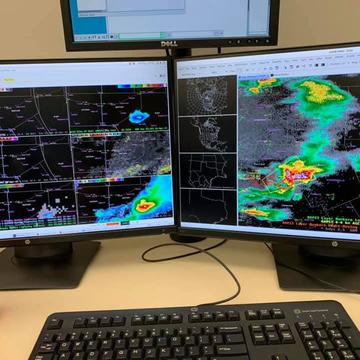
Looking at tornadoes on radar
Has there been something about the research process that surprised you?
One thing that surprised me early on was how much coding and debugging is really part of research! When you first start coding, it can feel overwhelming because you assume you should understand everything immediately, but it actually takes years to build those skills. I learned that a huge part of research is just being logical and persistent, looking carefully at your results and asking whether they actually make sense physically. Having supportive supervisors who help guide you through that process makes a huge difference.
Do you have a favourite climate model?
I think I’d probably say the UK Met Office HadGEM model, mainly because I spent so much time working with it during my PhD. I used a multi-model approach, comparing models with different resolutions, particularly over the North Atlantic. The higher-resolution models were much better at representing certain turbulence mechanisms, especially mountain wave turbulence, so I became very attached to those models after spending years analysing them.
Do you have a favourite extreme weather phenomenon?
I always feel slightly guilty answering this because these events can be devastating for people, but tornadoes are absolutely fascinating. Seeing one in person is breathtaking. There’s something very primal about watching the sky darken beneath these huge rotating storm systems and seeing a funnel cloud reach the ground. The UK actually experiences a surprisingly high number of tornadoes relative to its size, especially in England, although ours are generally much smaller and shorter-lived than those in the United States. Technically we have more tornadoes per square mile of landmass though! There's actually a hotspot, a tornado alley in the UK between Reading and London, and at Guildford is like the peak of when there's the highest number of tornadoes. It's very cool. They’re incredibly powerful and destructive phenomena, but scientifically they’re also fascinating.
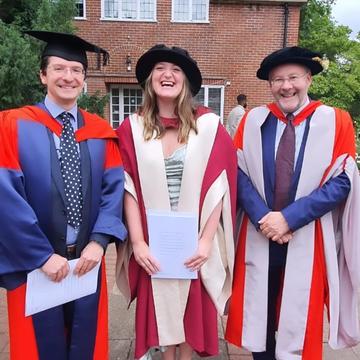
At graduation with Paul Williams and Giles Harrison
What’s something about the atmosphere or climate that would surprise most people?
A lightning strike is actually around five times hotter than the surface of the Sun. The electrical discharge heats the surrounding air so intensely that it creates plasma and causes the air to expand extremely rapidly, which is what produces thunder. Temperatures inside a lightning channel can reach around 30,000 °C, which is just incredible to think about.
Have there been mentors or role models who shaped your career path?
I’ve been really lucky to have fantastic supervisors and mentors throughout my career. During my undergraduate dissertation I worked with Giles Harrison and Graeme Marlton, who are both experts in lightning research, and they were brilliant. Then during my PhD I worked with Paul Williams and Reinhard Schiemann who were both hugely supportive. And now at Oxford I work with Thomas Aubry, who is an expert in volcano-climate interactions. Each of them has shaped my career in different ways and taught me something valuable.
What’s your favourite thing about working at Oxford Earth Sciences?
The community. Everyone is so kind, supportive and genuinely interested in each other’s research. Coming from a much smaller postdoc community at Exeter, it’s been really nice arriving somewhere with such a large and active early-career researcher community. You can sit in the common room and easily start conversations with people, and everyone is very welcoming. Also, the free coffee at 11am probably deserves an honourable mention [laughs].
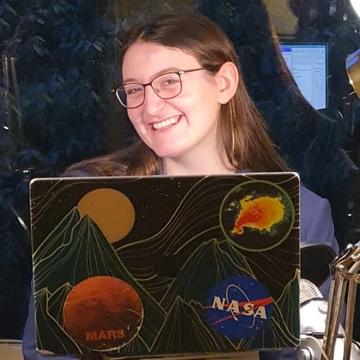
Presenting to the FAA
What advice would you give to students considering research in climate science or meteorology?
Honestly, I’d say start by looking outside. That sounds simplistic, but developing genuine curiosity about the atmosphere is really important. There are amazing resources available online now, like the European Centre for Medium-Range Weather Forecasting (ECMWF) and Met Office websites, where you can explore weather data and forecasts in incredible detail. If you build that curiosity and passion naturally, then pursuing it at university becomes much more enjoyable because you’re studying something you’re genuinely fascinated by.
What motivates you as a researcher?
What motivates me most is knowing that the work contributes, even in a small way, to improving our understanding of climate change. The volcanic forcing datasets we work on feed into climate model simulations used by researchers all over the world. I’m only one small part of that process, but it still feels meaningful knowing that the work contributes to research that may ultimately help protect people and communities from the impacts of climate change.
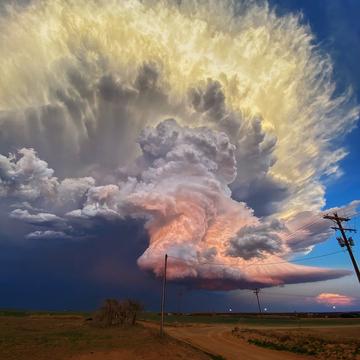
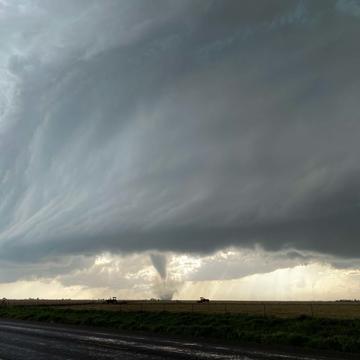
Cloud formation (credit: Laura Rowe, Storm Chaser https://www.facebook.com/story.php?story_fbid=3985519364861889&id=100071...)
What has been the proudest moment in your career so far?
At the end of my PhD, I was invited to present my research to the Federal Aviation Administration in the United States. It was during the pandemic, so it happened virtually, but there were around 70 or 80 people there, many of whom worked directly on aviation safety. It was a real “pinch me” moment, presenting my work to people who genuinely valued it and seeing how relevant the research was beyond academia. It was also slightly surreal because people kept referring to me as “Dr Smith” even though I didn’t technically have my PhD yet! I was sat there on the Zoom call thinking they were talking to someone else [laughs].
What excites you most about the future of climate and atmospheric research?
What excites me most is how motivated and passionate people in the field are. Climate change can feel overwhelming and quite depressing at times, so it’s genuinely encouraging to work in an environment where so many people are actively trying to improve things and push research forward. Being surrounded by that sense of purpose and optimism is really inspiring.
What’s your favourite piece of fiction that involves Earth Sciences?
It has to be Twisters! Watching storm chasers on screen felt surreal because I’d actually done storm chasing myself in Oklahoma. Some of the things they do in the film are completely unrealistic, like driving directly into tornadoes, which nobody sensible would ever do, but it’s still incredibly entertaining! The atmosphere, the storms, the music, everything about it is just great fun.

