

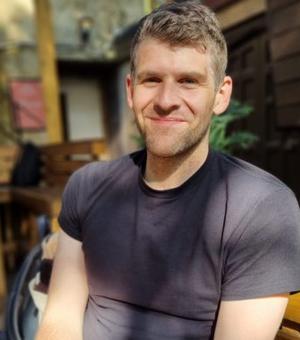
Richard Thomas
Experimentalist interested in understanding the behaviour of volatiles in silicate melts.
My research focuses on defining the chemical behaviour of volatile elements, particularly the halogens and sulphur, in silicate melts. I seek to understand how these components control melt structure, redox state, physical properties, and the composition of exsolved fluids and quenched glasses. Achieving this requires a rigorous thermodynamic framework that links volatile speciation, bonding environments, and fugacity conditions. To address these questions, I develop and calibrate fugacity-buffering techniques and conduct high-pressure, high-temperature experiments on synthetic silicate glasses. By combining controlled experimental systems with thermodynamic modelling, my work aims to quantify volatile–melt interactions and constrain the fundamental parameters governing volatile transport and magmatic differentiation.
I am supervised by Bernard Wood, and part of the experimental petrology group.
-
Thermodynamics and redox chemistry of volatile elements in silicate melts
-
Chemical behaviour of halogens and sulphur at high temperature and pressure
-
Volatile–melt bonding environments and their influence on melt structure and properties
-
Fugacity-controlled experimental petrology and buffer development
-
Volatile-driven redox evolution in magmatic systems
-
Fluid–melt equilibria and volatile exsolution processes
-
Metal speciation and transport in magmas and ore-forming environments
-
Quantitative experimental constraints on volatile mobility in crustal and mantle settings
WORCESTER COLLEGE, UNIVERSITY OF OXFORD SEPT 2017 – APRIL 2022
DPhil in Experimental Petrology/Geochemistry
Initial 6-month taught programmes with the Doctoral Training Partnership including modelling in Python, and advanced quantitative/mathematical methods. Thesis title: “The thermodynamic properties of halogens in silicate melts.” Supervised by Professor Bernard J Wood.
UNIVERSITY COLLEGE LONDON OCT 2015 – OCT 2016
MSc Geochemistry – Distinction in all modules
Thesis title: “Can pseudotachylytes tell us about the thermal history of faults?” Supervised by Professor David P Dobson.
UNIVERSITY OF EXETER 2009 – 2012
BSc Geology - First Class Honours
Studied modules including Geophysics, Chemistry, Mathematics, igneous and metamorphic petrology and Thermodynamics. Thesis title: “The use of Euglena mutabilis in the remediation of acid mine drainage and simultaneous production of metal concentrates and biofuel.” Supervised by Dr Chris Bryan, at the Environment and Sustainability Institute.
UNIVERSITY COLLEGE CORK, IRELAND JAN-MAY 2021
Lecturer in geochemistry
I ran a geochemistry module to cover maternity leave. This involved creating and running tutorials and lectures, setting practical sessions, writing exam papers, and assessing the grades of 24, 4th-year students.

