


Not Just a Carbon Sink: Weathering Found to Drive Ancient Global Warming
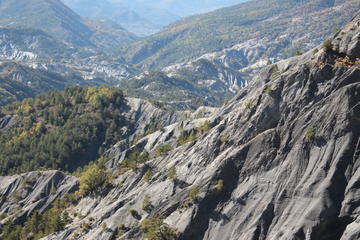
Modern day shales in France, being weathered by erosive processes. Image credit: Professor Bob Hilton
A new reconstruction featuring authors from Oxford Earth Sciences has shown that chemical weathering can contribute to global warming. The study, published today in Nature Communications, demonstrates that weathering of carbon-rich sedimentary rocks can release carbon dioxide to the atmosphere, and confirms that this contributed to rising temperatures in the Early Jurassic, 183 million years ago. This important new study highlights an overlooked climate mechanism that may have also been active in other periods of geological time.
Until recently, weathering was primarily considered a way in which carbon was removed from the atmosphere; a process which locked CO2 away due to chemical reactions between rainwater and silicate rocks. This regulated Earth’s climate in the past, especially during periods of rapid warming. However, new research has shown that weathering can also intensify warming on geological timescales when the rocks being eroded are rich in organic carbon.
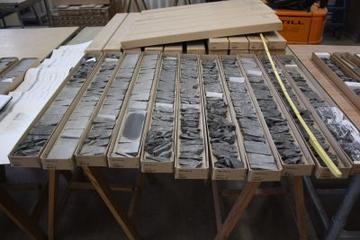
The Mochras Farm Borehole core. Image credit: Stephen Hesselbo
“Weathering of sedimentary carbon-bearing rocks, such as shales, can emit significant quantities of CO2, causing temperatures to rise and further weathering to occur,” said Professor Bob Hilton, co-author of the study. “We see this effect in our measurements of weathering in modern fieldwork studies and in the laboratory, but until now, observing this in the past has proved a challenge.”
Now, researchers have shown that weathering of sedimentary rocks during the Early Jurassic became more intense when Earth’s climate was warmer. This is the first demonstration that this process was operating as a positive feedback during geological history.
The research examined weathering during the Toarcian Oceanic Anoxic Event in the Early Jurassic, 183 million years ago – also known as the Jenkyns Event, after Emeritus Professor Hugh Jenkyns, who dedicated years of research to this period.
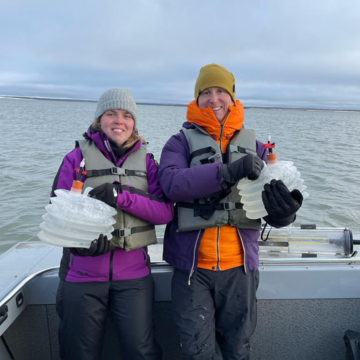
Dr Madeleine Stow and Professor Bob Hilton conducting geochemical fieldwork in Canada. Image credit: Professor Bob Hilton
“By measuring rhenium isotopes in rocks from the Llanbedr (Mochras Farm) Borehole in Wales, we were able to reconstruct how the rate of sedimentary rock weathering changed throughout this period,” said Dr Madeleine Stow, lead author of the study. “We then complemented this with two numerical models which independently came to the same conclusion – that this type of weathering became more important as temperatures rose, and that this would have released significant amounts of CO2.”
Previous work published by researchers from Oxford Earth Sciences used mercury concentrations in the Mochras Farm Borehole to demonstrate that the Toarcian Oceanic Anoxic Event was triggered by extensive volcanism which injected CO2 into the atmosphere and caused warming. However, they also noticed that the amount of CO2 originating from volcanic activity was less than would have been required to cause the observed temperature increase – and therefore there must have been another process in play.
This new study proposes that this “missing carbon” came from sedimentary rock weathering, which contributed approximately 7 to 20 trillion kilograms of carbon to the atmosphere and oceans within less than a million years. Not only do the findings of this study provide a source of the missing carbon during the Toarcian Oceanic Anoxic Event, they also highlight that weathering has a complex role to play within the global carbon cycle. The research team are keen to investigate whether this also occurred during other hyperthermal events in the geological past.
“The Earth’s carbon cycle controls global climate change, but its behaviour is complex to understand. Using a new approach, based on the metal rhenium, we were able to show that so-called oxidative weathering, which has been hypothesised as an important mechanism in the carbon cycle, actually helped drive a period of rapid global warming in the past. What is also exciting is that this study builds on many years of research to develop the rhenium proxy approach, which may now open up the opportunity to explore how weathering controlled carbon dioxide release in other periods of Earth’s history.”
- Professor Alex Dickson (Royal Holloway), co-author of the study
This study is the culmination of a decade of research by the Earth Surface Geochemistry research group, the Department of Earth Sciences at Royal Holloway University of London, and the University of Durham. This research has explored the relationship between the weathering of sedimentary rocks and rising temperatures in the modern day, and led the development of rhenium isotopes as a proxy for this process.
The study ‘Rhenium isotopes reveal enhanced rock organic carbon oxidation over the Toarcian Oceanic Anoxic Event’ is available to read in the journal Nature Communications at https://doi.org/10.1038/s41467-026-71533-6. The research was funded by a grant from the Natural Environment Research Council (NERC) with collaborators from Royal Holloway, Durham University, Université Savoie Mont-Blanc, and the University of Exeter.

