


UKRI funds SEQUIN project to probe Earth with a hybrid quantum array, on the path to sensing the cosmos
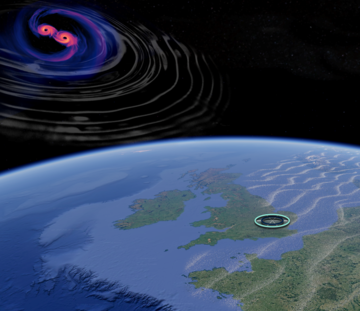
Illustration of hybrid array disentangling seismic waves in the Earth and gravitational waves from outer space. Image credit: Jeremiah Mitchell (GoogleData SIO, NOAA, U.S. Navy, NGA, GEBCOLandsat / CopernicusIBCAOU.S. Geological SurveyGeoBasis-DE/BKG (©2009), Inst. Geogr. Nacional)
A major grant of £1.2 million from UK Research and Innovation (UKRI) is funding Sensing the Earth with a novel QUantum-classical INterferometer array (SEQUIN), an interdisciplinary collaboration between Oxford Earth Sciences and the Many-Body Quantum Dynamics Group at the Cavendish Laboratory, University of Cambridge. The project brings together quantum sensing and seismic monitoring to improve the detection techniques of extremely faint signals from gravitational waves in space to deep vibrations within the Earth.
Gravitational waves have transformed how we understand the universe. These ripples in spacetime originate from the most dramatic events in the cosmos, such as colliding black holes, but they are very difficult to detect. Before colliding, black holes orbit each other, producing long lived gravitational waves that provide more information about their sources. Quantum sensors can measure these faint signals, but they can be masked by natural and human-made ground vibrations (seismic waves).
Conversely, the Earth’s free oscillations are low-frequency vibrations that occur after the planet experiences a large-magnitude earthquake, characterised by natural resonant frequencies. These vibrations are sensitive to structures deep inside the Earth and are equally difficult to detect, even using large networks of seismometers.
The SEQUIN project will tackle both these challenges through a hybrid approach, bringing together the expertise of Professor Mike Kendall, Associate Professor Paula Koelemeijer, and Dr Tom Kettlety of Oxford Earth Sciences with that of Professor Ulrich Schneider and Dr Jeremiah Mitchell at the University of Cambridge.
"This exciting project is all about bringing the worlds of Earth sciences and quantum physics together. We’re trying to combine the way we normally do things in seismology (i.e., measuring earthquakes) with state-of-the-art sensors that use quantum physics to measure gravity incredibly precisely. By building a sensing system where the seismometers help the quantum sensors and vice versa, we will develop methods to detect very difficult to measure signals, like the echoes of the deepest parts of the Earth, and potentially signs of fundamental phenomenon like gravitational waves and dark matter," said Dr Tom Kettlety.
"At the same time, the seismology data we’ll be collecting will also be used for very practical applications. In particular, this will fill in a gap in observations of natural earthquakes in the southern North Sea. The data will also be used to develop signal processing methods to better extract information about those earthquakes. This will aid efforts in monitoring and de-risking an industry that’s critical for stopping climate change – geological CO2 storage – which is actively being deployed in the UK and worldwide."
"The unprecedented sensitivity of the atom interferometer at very long periods provides a new way of measuring some of the faintest signals in both physics and Earth sciences. This enables exploration of the most difficult to observe standing waves of the Earth, opening up new ways to study the deep Earth."
- Associate Professor Paula Koelemeijer
“This opens the door not only to improved gravitational wave detection, but also to a deeper understanding of the Earth’s internal processes,” added Professor Mike Kendall. “The system will achieve far greater precision than either instrument could alone.”
“Bringing together physics, quantum technology and Earth sciences, this project will reveal a new way to explore both the cosmos and our planet, taking a major step forward in gravitational sensing and a powerful new tool for studying Earth’s deep interior and environmental processes,” concluded Prof Ulrich Schneider.
The project is further strengthened by contributions from project partners, including the United States Geological Survey (USGS), UKRI-STFC Boulby Underground Laboratory, the University of Glasgow, and the Université de Strasbourg, who will provide expertise and specialised instrumentation, specifically precise and novel seismometers, to enhance the hybrid sensing network.

