
Earth Sciences in Conversation: Adam Morley

Our Earth Sciences in Conversation series explores the lives and careers of members of the Department, showing readers the people behind our world-leading research. For this issue we sat down with Adam Morley, DPhil student and Officer in the British Army, to learn more about his career in the armed forces, doing a DPhil mid-career, and detecting long-lost medieval tunnels in Normandy…
Interview by Charlie Rex

Tell us about your fascinating career outside academia!
I am an officer in the British Army, and I have been for 19 years. I commissioned from the Royal Military Academy Sandhurst in 2006 into the Corps of Royal Engineers, and since then, I have done overseas deployments to the likes of Northern Ireland, Kenya and Afghanistan. I've also done a number of appointments in defence intelligence and UK counterterrorism and resilience.
Why did you decide to go into the armed forces?
When I signed up for Sandhurst, I was 22 years old and drawn to the mental and the physical challenges presented by the training and being a young army officer, as well as the prospect of overseas deployments. That was really the motivation – I just wanted to see if I could get through Sandhurst and become an officer. If I'm to be perfectly candid, I was thinking of only doing a few years, yet here I am 19 years later!
19 years is a long time! What encouraged you to stay for so long?
How a lot of the armed forces work is that there are postings, and you tend to be posted for two to three years before you move on to a different job, which is sometimes at a higher rank. And that has probably kept me interested, because you're always being challenged with new things and new responsibilities. Moving your family every few years can take its toll but from a professional perspective it tends to be quite exciting, which is probably why I'm still in.
Had you or your family had any experience with the armed forced prior to you signing up for Sandhurst?
None whatsoever! I was a long-haired hippie for my whole time at university. It was only during my final year that I became a little bit saturated with academia and wanted to try something completely far removed from anything I was used to. I went to a careers fair at Leeds University when I was a fourth year and came across the desk on Sandhurst and being an army officer. I started asking some questions to a retired Lieutenant Colonel and then before I knew it, I was sat in an interview room, and then I was under some assessments, and then I got in, and then I got my hair cut and that was it [laughs].
A drastic change indeed! You weren’t tempted to grow your hair during your DPhil then?
No, but I did grow a beard, which was a nice distraction! The irony is that you are now allowed to grow beards in the Army, which changed whilst I was doing my PhD. But I don’t think I can allow myself to have a beard in uniform, so it will be coming off before I start my next military appointment! Maybe when I eventually leave, I will grow my hair long again.

Adam used Ground Penetrating Radar (GPR) used to verify subsurface anomalies found in high-resolution multispectral satellite imagery.
What motivated you to do a DPhil later on in your career? How did that opportunity come about?
I have always been interested in finding things below ground. That is probably why I ended up doing undergraduate Geophysics at Leeds before the Army stuff, and then it wasn't until I was in the Army and in Afghanistan in 2010 when I encountered first hand subterranean warfare and tunnels being used in anger by insurgents. We see at a strategic level the complexity and the severity of subterranean warfare, including the risks presented by cross-border tunnels in the likes of India, Pakistan, the US, Mexico, and so on, so I felt like there was a real use case there. And then when I did some appointments in defence intelligence, I learnt more about air and space remote sensing. Given my experience with each of these, I thought there was an opportunity to marry it all together in a piece of research which has benefits for defence and security, but also more broadly, for other communities like archaeology and environmental agencies. All that combined tipped me to submitting a proposal to the Army to see if I could be released to do this research through the EPA – the External Placements Academic programme – and I was fortunate enough for it to be granted.
What drew you to this department in particular? Do you have a favourite thing about Oxford?
It was actually first and foremost the people. My primary supervisor, Professor Mike Kendall, was someone I worked with at Leeds University, where we got a paper published together and had a good working relationship. When I first started thinking about this research, my first thought was that I should find out where he was based. To discover he was working in Oxford was great, because of course the city is stunning, and the University is very high profile. I was very lucky to find a supervisor who was willing to trust my ambitions and then strengthen my application, which then probably helped me get approval from the Army. Once Mike was happy to support, I had to go through the regular procedures of applying and getting an offer, and then quite literally since then there has been no looking back! I've loved every minute of it.
Is it common to gain university or research experience whilst a member of the armed forces?
There are lots of opportunities. I wouldn't necessarily say it's common, but frameworks like the EPA programme are really good at providing the opportunity for individuals to go away and professionalise themselves in academia. There’s one slot every calendar year for someone to go away and do a PhD full time, so I was fortunate to be selected. But they also offer a series of opportunities for masters. Then of course we also have the Defence Academy at Shrivenham and that is basically our military university. At different points in one's career, particularly in the officer ranks, you can undertake a career course where you are presented with research challenges and opportunities to work with other universities. There are these frameworks in place, but I would say that from my experience, it's up to the individual to find them and then apply and pursue them. They are not always presented to you, but they are there.

(L-R) Adam using gravity surveying, a thermal drone, performing height corrections for gravity, and electrical resistivity tomography
What questions have you been investigating as part of your research?
The first is the “why?” – why would anyone wish to remotely sense the subsurface from platforms and from air and space? And then I moved on to “what?” – what are the unique ground indicators and potential field characteristics are present above a subsurface anomaly or a subsurface structure? I needed to understand what unique indicators at ground level would signify there being a discrepancy below ground, and they range from things like visual identification, like changes in soil and vegetation, to thermal properties, magnetic properties, gravitational properties, and changes in micro relief. And then the “how?” comes in – what are the major sensor types, what sensor types do I have available, which ones are best placed on drones or planes or satellites, and then how can you manipulate the data that is received by those sensors to emphasise these unique ground indicators? From there, I was keen to see if I could forge numerical relationships between my high resolution remotely-sensed data and geophysics, so using numerically and statistically geophysics to then validate some of these detection techniques.
How have you found the world of research?
I have absolutely loved it, like genuinely loved it. I think it's helped that it was my own proposal, and really my own brainchild. When I woke up every morning I always had a bit of a spring in my step, and I was very focused and energised. I've absolutely loved the city and the University because it is so resource-rich with people and their expertise and their connections. The Bodleian Library services in particular are exemplary. I spent a lot of time in the libraries because I like working there, and with the heritage parts of my research I was leaning into some quite old historical references, and the Bodleian were in real support of that. And I think ultimately, it's just been the freedom to innovate and the freedom to think and to pursue your own research objectives which has been really great.
What motivates you as a researcher?
I think for me it goes back to why I wanted to do this in the first place. From both a heritage and a defence perspective, finding something anomalous below ground and then being able to validate it and potentially even explore it is really exciting. It's that detection and exploration that I love so much. Coming up with ideas for work around Glastonbury Tor and Cistercian monasteries in France, and understanding more about what, for example, the order of Cistercians were doing – whether it was all tunnels for hydrology or other means – has been really fascinating.
Are there any skills or experiences from your non-research career that you think have helped you during your DPhil?
It may sound a touch mundane, but definitely time management. I always knew I had only three years to finish the DPhil, so I have had to prioritise a lot. I know everyone can prioritise, but I have had to be quite rigorous with my time in not doing stuff even when I want to. I’m generalising, but in the Earth Sciences community I think a lot of us like to analyse and play with data and we like to evaluate things. Lots of us like to admire a problem – I like to admire a problem! But you can't admire problems for too long, you've got to get it done. I was surprised at how much decision making there is in a PhD, whether it's how you're going to structure a paper, the subheadings, the figures you are going to use, what your conclusions are. There are decisions all the time and I didn't see that coming to be honest. And so, in terms of that self-discipline, I think the Army's been really good for me.
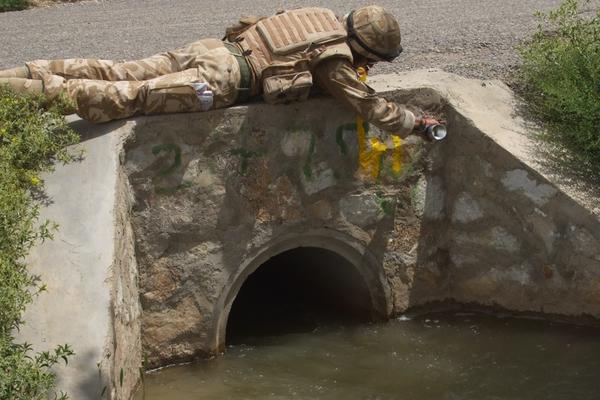
Identifying, tagging and mapping culverts along main supply routes (MSRs) in Helmand Province, Afghanistan (2009)
The collaboration between industry and academia is fairly well-trodden, do you think that the armed forces and academia can work together in a similar way?
Yeah, I do. I do think there's definitely more that can be done with professionalising individuals in defence. Academically, it would need to ensure that those that are professionalised are clearly doing something for the betterment of defence, but also I think it needs to be arranged that then that individual is assigned a specific role in defence that will then capitalise on what they've done in said University. I think there could be better arrangements in place to do so. Less, of course, the Defence Academy in Shrivenham, which does a good job. But working in other universities with experts from around the world would go a long way.
You originally studied geophysics at university – what (or who) inspired you to pursue this degree when you left school?
Good question! I always liked maths and science at school, but I also really like being outdoors. I didn't even know about geophysics until I went into my careers library at school, looking for information on geology. There were these one-page summary flyers on the different things you can do at university, and someone must have signed out geology because it wasn’t there. But geophysics was, and there was a paragraph about the day in the life of a geophysicist, and it talked about camping near a volcano and going up to the crater of to do all these different tests. I was just sat there in this library in my local comp school in Plymouth thinking my goodness, wouldn't it be nice to camp on the side of a volcano? And that was it. Ironically, I never really did much volcanology at all! But I was very into the maths and science of the Earth from that day on. And you know what, maybe if the geology flyer hadn't been signed out, I would have just picked up geology and walked off!
What is the proudest achievement in your career so far?
One of my jobs when I was out in Afghanistan as a battle group engineer was to work in an area where there was lots of what we call MSRs – main supply routes. These are rather big roads that would often carry large convoys, but they were riddled in culverts. A lot of these culverts were dried out and dysfunctional, but unfortunately, they were great containers for putting explosives for IEDs (improvised explosive devices) to then initiate when a convoy was travelling across the top. And I had to identify and map where all these culverts were along kilometres and kilometres of these main supply routes and then I had to determine which ones we could render safe by plugging with concrete. I ended up plugging up about 2/3 of these culverts that were completely dysfunctional, therefore rendering them safe and making these main supply routes as a safer place to travel. That was a bit of a success story from an engineering perspective whilst out in Afghanistan on Operation Herrick.
What’s the coolest subsurface feature you’ve detected during your research?
I think hands down it has to be a medieval tunnel that I found in Normandy, France, running from a medieval grange, then under a Cistercian Abbey. It was a great tunnel that was incredibly well built and obviously stood the test of time. Finding the entrance that tunnel and actually going in and doing a little bit of excavation work to understand more about it was brilliant.

Exploring a medieval tunnel in Normandy, France
Did you discover that tunnel? Or did people know it was there before, and you just detected it?
Yes, I found it! No one knew it was there, including the landowner. The last time someone would have known it was there was during the occupation of Cistercian monks. In between then and now the land has been owned by farmers and even if they know about it, they just left it alone. This thing has been untouched for hundreds of years and it was fantastic to find it.
You have used eight major sensor types during your research – which is your favourite?
I think I have to say multispectral because I've used it a lot and I think there's a lot you can do with it. Each pixel value holds a number of reflection values from different parts of the electromagnetic spectrum, and there's a lot you can do with that when you start blending different values together from different parts of an image. And I suppose that works nicely in harmony with hyper spectral, even though I haven't done much with hyper spectral imagery. But that's very much the same principle, but with even more reflection values per pixel. But I do like them all in different ways!
If you could choose one mode of transport – terrestrial or otherwise – to always attach a sensor to (so every plane, every boat, etc.), what would you chose?
Good question. I've got an answer, it's a bit of a cop out, but I think it's fair! It depends on the use case – this is with my defence hat on here. If it requires global surveillance, then I’m going to pick a satellite. We've got satellite constellations now, particularly commercial constellations, which can pretty much image the entire surface of the Earth in a day. The revisit times are really good. If it's a regional or an operational problem, I would pick a plane. If it was a specific site or a tactical problem, I would pick a drone.
What developments in remote sensing research do you think will happen in the next decade?
Obviously, machine learning is not going away, and I think from a subsurface perspective with remote sensing, it's a really exciting time to interface multi sensor data sets with machine learning. As an example, with CNNs – convolutional neural networks – it would be really exciting to see how effective they would be at detecting subsurface anomalies in an image in terms of object recognition. But then going a step further to understand if that linear anomaly is in fact statistically significant compared to its surroundings and then flagging that up to a user. That's so exciting and I hope it gains momentum in in the next 10 years.
You just submitted your thesis, congratulations! What’s next for you?
In three days’ time I start at the big MoD operational headquarters at Northwood. I will sit in the capability arm of that headquarters where I will become a programme manager for new geospatial technology coming into defence. The role is tri-service, so I will be looking at new bits of geotechnology for the Army, for the RAF and the Navy. And I will be managing these programmes reading lots of business cases, writing lots of business cases, granting money to certain things, turning money, turning things off, granting more time, giving people less time, and seeing where that takes me. That’s all I know about my new job at the minute, but that is what I'll be doing from next week! One of the programmes is on imagery exploitation, so there should hopefully be lots of synergies between that programme and some of the stuff I've done in this research. So, I'm pretty excited to be working with that programme in particular.

