


Earth Sciences in Conversation: Erin Saupe

Our Earth Sciences in Conversation series explores the lives and careers of members of the Department, showing readers the people behind our world-leading research. For this issue we sat down with Erin Saupe, Professor of Palaeobiology, to discuss the role of palaeontology in responding to climate change, the challenges and opportunities of increasing diversity in the geosciences, and the scientific inaccuracies of Jurassic Park…
Interview by Charlie Rex
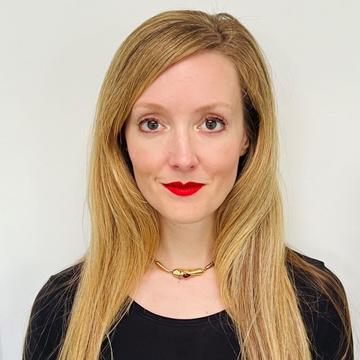
What (or who) inspired you to get into Earth Sciences?
I've always really loved the natural world, but my original passion was archaeology and human history. It wasn't until I took an introductory geology class in the first year of my undergraduate degree that I really fell in love with Earth Sciences. My professor in that class – his name was Larry Davis – was an amazing teacher, and it was his passion and ability to make the history of life really fascinating that hooked me on Earth Sciences. And what I particularly loved was understanding why we see the features around us that we see – mountains, rivers etc.
Tell us about your university journey and career path so far
I began my undergraduate degree thinking I'd be a historian, but after I fell in love with the history of the Earth, I switched to a Natural Sciences degree, where I studied both biology and geology. I did my undergraduate at the College of Saint Benedict in Minnesota, and then my MSc and PhD at the University of Kansas. Kansas has a really long history of palaeontology – they published the Treatise on Invertebrate Palaeontology, which is basically an encyclopaedia of fossil organisms – and I was looking for a programme that was strong in palaeontology. After my PhD I got my postdoctoral fellowship at Yale, and I was at Yale for two years before I got the faculty job here in Oxford.
Was there a particular moment when you decided to study palaeontology? When did you decide to make it your career?
I wasn't actually sure what I wanted to be for a while. Even when I got to the end of my undergraduate degree, there were two options I was considering. One was scientific journalism, because I really enjoyed writing, and the other was palaeontology. I decided to do a masters in palaeontology to basically kick that decision down the road [laughs]! So, it was cheating a bit in the sense that I thought “well, if I get a master's, I'll have that scientific background, and then I could always go and be a scientific journalist”. As I got into my own research, I realised I really loved that process of discovery and being able to figure out how the world works. And from then on, I knew I wanted to do a PhD and continue that academic track. I was really motivated by getting to ask my own questions and figure out a research problem that no one else had the answer to. And why palaeontology? Well, I’ve always loved animals, and history, and solving puzzles, and palaeontology was the perfect combination of those different things. I get to figure out why life is the way it is, and I get to study the past.
What motivates you as a researcher?
I think what motivates me is the process of discovery. I want to figure out what life was like in the past, and I want to know why it was like that. And I'm really motivated by answering questions about the past that might help us better understand biodiversity today, and potentially even help conserve biodiversity. Some of my work is focused on conservation palaeobiology, which is the subdiscipline that uses fossils and historical data to inform present day conservation. Because I really love animals and plants, I want to try to do everything I can to help preserve the biodiversity alive today.
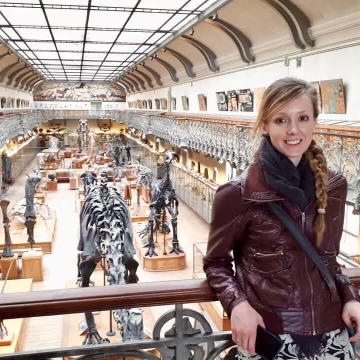
Tell us more about your work in conservation palaeobiology. What lessons can we learn from the past about current day pressures on biodiversity?
That’s a great question, and it's actually something I'm really passionate about. We can actually learn a lot from the fossil record about how species respond to climate change. We know that climate has changed a lot in the past, and so we can look at fossils and where they lived, correlate them with climatic conditions, and understand how they might have changed in response to environmental changes – both in terms of their distribution and their morphology. Sadly, that’s relevant today. As climate is continuing to change, we can learn what traits make species vulnerable to extinction. We can also get a sense of where species used to live before large-scale human impacts. And that again might give us a better sense of where we can conserve species today, by putting them in areas we know they used to live.
What’s your favourite part about teaching on our undergraduate course?
I love that teaching is a two-way street. Our undergrads are so engaged, they think so critically, and they often push me to learn new things or to think in different ways. I've realized that I don't fully understand something until I have to teach it. So, I think teaching is a great way to force somebody to fully understand something. And then, even when you do that, our undergraduates push me to think about things in new ways because they are so switched on. My favourite part about teaching is, of course, inspiring a love for palaeontology. Getting the students interested in the subject that I love is really rewarding.
Do you have a favourite thing about working here in Oxford?
I think we get really amazing people through the door, from undergrads to grad students to postdocs to faculty to visitors. And I think it's awesome to be part of such an intellectually dynamic environment. But, I think what's perhaps even better is how friendly and welcoming our department is – it makes going to work each day a joy.
What is the proudest achievement in your career so far?
I think this is a very difficult question, but one of the pieces of work that I'm really excited about is a collaboration with colleagues from China and the US where we simulated the latitudinal diversity gradient using first principles. The latitudinal diversity gradient is one of the longest known patterns in ecology. It's where the number of species increases as you go from the poles to the equator. We were able to generate this pattern using a simulation framework. What our simulation suggests is that there may be more species at low latitudes because of the way that climate, and specifically precipitation, changes spatially and over time, which induces more speciation at low latitudes. And this is really cool, because biologists, ecologists, and palaeontologists really care about these broad scale patterns and want to try to understand how and why they form. So, being able to simulate a pattern from first principles from no pattern whatsoever may provide us with a clue as to the mechanisms that are actually controlling these large-scale biodiversity dynamics.
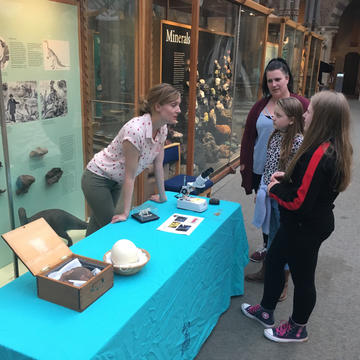
You’ve recently become a Mum, congratulations! Has motherhood changed how you view or approach your career?
My daughter just turned 8 months old on Friday! Becoming a mother has definitely put things in perspective. It's made me realize that some of the things I used to worry about or care about in my career are perhaps not as important as I once thought they were. I think having more work-life balance is really important to me. As an aside – and from a palaeobiology perspective – it’s made me realise how bizarre human evolution is, given how useless humans are as babies! It’s wild [laughs]. I knew this intellectually, but now I know from my lived experience that babies are so “larval” for so long!
What would you say to someone just starting out in palaeontology research?
I'd say that learning to code and do statistics is probably one of the most important things you can do to further your paleontological career. That’s surprising to some, because most people wouldn't think of palaeontology as a very quantitative field, but more and more it's becoming that. You need to have a strong coding basis to do your analyses. I'd also say that actually having interesting questions and being curious is key. Letting your curiosity fly and making sure you know the literature really well; those are going to be really important for a successful career.
You are the Department’s AHoD for People and EEDI. What do you think the biggest challenge is for Earth Sciences right now in terms of diversity? What’s the biggest opportunity?
It’s a tough question. I think there are a lot of misconceptions about Earth Sciences, both about what you have to look like (for example, maybe Indiana Jones!) and what you have to do. And I think we need to break down those barriers so that we can attract a diversity of individuals into the subject. One of the biggest challenges is that our subject lacks diversity, especially BME diversity. But I think that's also one of the major opportunities. Attracting more diverse minds to the field will provide a range of perspectives, and that is going to push forward our science. There's a lot of work to suggest that diversity increases intellectual output, which will increase our ability to understand the natural world. And I think one of the ways to do that is making it clear that there isn't one way to be an Earth Scientist, there are a lot of different avenues. You can be an oceanographer, or you can be a climate scientist, or you can be a biologist like I am, or you can be a more classic field palaeontologist, or you can be a sedimentologist, etc! It's just such a broad subject that it should be easy to attract diverse individuals, but that there is this misconception about it.
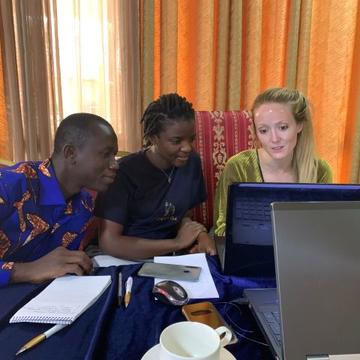
What is your favourite geological time period? Which one would you most like to live in?
I want to go back to the Ediacaran to see those first macroscopic organisms, and to see if some were indeed the first animals and whether some others were evolutionary dead ends. I also think that our planet would have looked wild back then, so it would be fun to see that. And then, quite predictably for a palaeontologist, I would totally live in the Jurassic to be with the dinosaurs, as long as I wouldn’t get murdered by them! That would be epic.
Do you have a favourite fossil?
My favourite fossils are heteromorph ammonites. Ammonites are cephalopods that are related to squid and octopus, but they have coiled shells they live in. The shells of heteromorph ammonites are uncoiled, and they often become uncoiled in very weird ways. So, they have lots of twists and turns, and they're very beautiful, but also very weird. There's been some debate about where they would have lived in the water column. It's really hard to imagine them floating around in the Cretaceous! But they are my favourite.
What’s your favourite piece of fiction that involves palaeontology?
I mean, there's clearly only one right answer, and anybody who answers this question differently is wrong. Jurassic Park. And it has to be the original, because all the others are rubbish. Literally terrible movies! But the original Jurassic Park movie is one of the top five movies ever. And it still stands the test of time. If any of our undergrads have not watched the original Jurassic Park movie that is just unacceptable, and I will be rethinking your grade [laughs].
How do you feel about people thinking that amber can in fact preserve dinosaur blood and therefore dinosaur DNA? I get that question a lot in schools!
Do you really? So, there's a couple of things. One is that blood is probably preserved in some form or fashion in insects that are preserved in amber. The issue is that the heat and pressure that amber has been subjected to has degraded the blood and therefore the DNA. So, it's really fragmented and it's really difficult to actually extract, if there is any remaining. Thus, we can't use blood from insects preserved in amber to reconstruct anything, much less dinosaurs. And then the second problem is that the amber that the original Jurassic Park movie used is from the Dominican Republic, and that amber is only about 15 million years old, and of course we know that dinosaurs died out 66 million years ago. So, there's a huge discrepancy and gap there. There are Cretaceous amber deposits, but they aren’t from the Dominican Republic.

What are you currently working on?
My lab is working on a lot of different things right now, but I think one of the projects that's the most fun is with my PhD student, examining the role of paleogeography on extinction risk. The idea is that shallow-marine-restricted invertebrates that live along east-west orientated coastlines are going to find it more difficult to migrate due to climate change compared to those that live along north-south coastlines. This is because temperature usually changes latitudinally, and an organism along an east-west coastline will essentially be stuck and unable to track their suitable conditions as climate changes. What we have found in our analyses that use fossil data is that palaeogeography matters, and where an organism lives plays a role in determining whether it will go extinct or not. The other important thing to note is that the continents have not always been arranged how they are today, so certain configurations might make it more likely for more species to go extinct. Some of my past work has shown this as well – in the Ordovician, for example, there were a lot of islands and not many north-south coastlines, so you got heightened extinction. I think this has relevance for understanding how species will respond to climate change today, such that shallow marine invertebrates living along east-west coastlines or on islands may be particularly prone to extinction. Intuitively this makes sense, but nobody has really shown quantitatively before that this has had an effect before using fossil data.
What developments in palaeontology do you think will happen in the next decade?
I think the field will increasingly use AI and machine learning in data analysis. And I think increasingly we'll try to study patterns across different temporal scales. Typically, a study will just look at one time scale or use one binning scheme as their temporal resolution. But, I think one of the things that we'll think about in the future is how patterns vary when you alter that time scale. Ultimately, though, to do this we need more data. So, I think that means going out and finding more fossils! And I think there's going to be an increased focus to try to do that in areas that have been underrepresented due to colonialism, such as the Global South.

