

The influence of low-spin ferrous iron on the oxidation state of the Earth's mantle

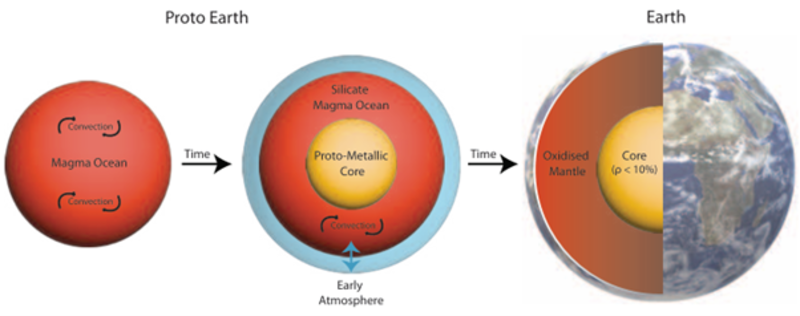
The Earth's mantle has elevated Fe3+ contents relative to those of other telluric bodies, a property thought to reflect the disproportionation of ferrous iron into its metallic and ferric counterparts during core formation. However, how the oxidation and electronic state of iron change as a function of pressure in compositions relevant to that of Earth's mantle are not fully understood. In this study, we present in-situ energy domain synchrotron Mössbauer spectra of 57Fe-enriched peridotitic- and basaltic glasses at 298 K compressed from 1 bar to 174 GPa in a diamond anvil cell. Glasses were synthesised with different Fe3+/[Fe3+ + Fe2+] ratios, 0.02 ± 0.02 and 1.00 ± 0.02, respectively, as determined by colorimetry. At 1 bar, the spectrum of the Fe3+-basaltic glass is well fit by a single doublet. In contrast, the spectra of both Fe2+-rich peridotitic and basaltic glass are fit by two doublets, D1 (~92 %) and D2 (~8 %) at 1 bar. As pressure increases, the integral area of the D2 doublet increases at the expense of D1 to reach a D2/(D1 + D2) ratio of 0.65 by 172 GPa. Because this transition is reversible with pressure and no metallic iron is detected, the D2 feature is ascribed to Fe2+ in its low spin (LS) state, whereas D1 is consistent with Fe2+ high spin (HS). This assignment resolves a long-standing controversy on the interpretation of the Mössbauer spectra of basaltic glasses. As a consequence of the stabilisation of Fe2+ with pressure, terrestrial planets more massive than Earth likely do not host increasingly oxidising mantles.
Venue
Seminar rooms
If you are external to the Department of Earth Sciences and wish to receive information about departmental seminars please join our mailing list by sending a message to: earth_sciences_seminar-request@maillist.ox.ac.uk

