


Earth Sciences in Conversation: Paula Koelemeijer

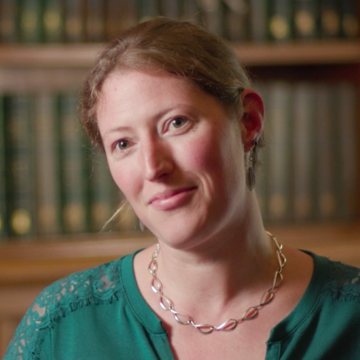
Our Earth Sciences in Conversation series explores the lives and careers of members of the Department, showing readers the people behind our world-leading research. For this issue we sat down with Paula Koelemeijer, Associate Professor of Geophysics, to hear about Earth’s music, skipping seismology lectures, and 3D-printing the world…
Interview by Charlie Rex
What (or who) inspired you to go into Earth Sciences?
The first moment I encountered Earth Sciences was when I was about 16. I was sitting in the corridor in school, having chosen our [GCSE equivalent] subjects for the year, and I was flicking through a friend’s Geography textbook. I saw all these stories and picture about rocks, volcanoes and earthquakes and was fascinated by it. However, I hadn’t chosen Geography at the time, so I asked if I could I still add it to my course load. Fortunately, they allowed me to pick up the subject a few weeks into the academic year. I loved it for about half a year, until the content changed to less physical topics. Being stubborn though, I stuck with the course until the final [A-level] exams! My mum, however, argues that I was inspired from an earlier age because as a child I used to pick up pebbles and bring them home. When I graduated, she gave one of my first pebbles back to me as a gift. My kids pick up rocks all the time, so I wonder what their future holds!
Tell us about your university journey.
I started with a bachelor's degree in Earth Sciences at the University of Utrecht in the Netherlands. At Utrecht, we could pick lots of different topics as part of our degree, and we were taught courses in the different science departments. After I started with some of the Physics courses, I enjoyed them so much that I ended up getting a minor in Physics. The trouble with these courses was they were often scheduled at the same time as my Earth Sciences lectures. Actually, my first course in seismology overlapped completely with the quantum mechanics course in Physics. Given it was much more important to attend the quantum mechanics lectures, I never actually attended any of the seismology lectures!
No way! But you are a seismologist!
I had friends who took good notes, and I read the textbooks, which was enough to end up as a seismologist [laughs].
Very impressive! What did you get up to after your undergrad?
I did a master’s degree in Geophysics at Utrecht as well. I really wanted to do a project on normal modes, which are the standing waves of the Earth that occur after large earthquakes, so I went to my seismology lecturer and told him that I wanted to do my project with him as my supervisor, but that I wanted to do it physically in the UK. He suggested a few people to reach out to, and I ended up approaching Arwen Deuss in Cambridge, who was happy to be my project supervisor. I spent the whole year in Cambridge doing my master’s research and I enjoyed it so much that I applied to a PhD – staying in Cambridge for another four years working on deep Earth seismology.
Where did you career take you after your PhD?
After my PhD in Cambridge, I moved to ETH Zurich in Switzerland and spent a year there working on computational seismology aspects. But by that point I had a boyfriend back in the UK, and I was looking for funding to come back here. I was very fortunate to receive a College fellowship in Oxford, so I spent three years in the Department here as a postdoc, working still primarily on deep Earth applications. I then applied for more senior research fellowships and was again very fortunate to receive a Royal Society larger fellowship that I took up at UCL. My time there was very short as I moved the funding to Royal Holloway to buy a house and start family life. After a few years there, I obtained my current position in Oxford as Associate Professor and Research Fellow.
You must like Oxford to have come back! What is your favourite thing about working here?
What I like about Oxford is the diversity in people. The interactions that you end up having are really varied, because you cross paths with people from very different backgrounds. This is particularly the case in a college setting, where you meet people who are not scientists. Even in the Department, we have people with backgrounds in chemistry, physics, biology etc, who I interact with on a daily basis. In Oxford, it is also very easy to start talking about a science problem and get distracted from what you're supposed to be doing, because it's so much fun to just discuss the science with people around you. I think that Oxford is great for that, partly because it creates an environment where those interactions are easy to have.
What’s the coolest thing you’ve ever detected using a seismometer?
That's a tough one, because we can observe all kinds of cool things on seismometers! For example, we can observe helicopters and trains, or different animals; the footsteps from elephants and giraffes, which are different. I often show the example of two elephants fighting with each other, as the signal almost looks like an earthquake. It is cool that when you look at the data, you suspect it’s an earthquake, but it turns out its two elephants colliding! I think it is also fun that our everyday lives and the movements of crowds can be detected on seismometers, for example, with the Taylor Swift concerts you could see crowds moving in different ways on the different songs. When I lived in Twickenham, we had a small seismometer in our house and we could see the trains going past and determine whether they were on time. But also the neighbours’ washing machines – you could see very clearly who was doing laundry at 6am on a Sunday morning [laughs]. However, when you think about it, what I think is even cooler is that my seismometer in London could pick up an earthquake in New Zealand. Those waves have travelled through the centre of the Earth and are detected on the other side of the planet after about 25 minutes. I think that is pretty cool!
Was there a particular moment when you decided on a career in academia?
There wasn’t necessarily one moment in time. Every step of the way, I’ve made choices based on what I’ve enjoyed doing most. I think at some point if I hadn’t been successful in getting funding then that would have forced a much harder thought process about my future. But I think what really cemented my career for me was the Royal Society Fellowship, because it provided research funding for many years, really securing my future.
Do you have a favourite earthquake?
The Bolivia earthquake in 1994, which was a magnitude 8.2 event. It was an earthquake that is very good for observing normal modes, but it also occurred deep in the mantle and therefore didn’t lead to many casualties on the Earth’s surface. This is the other side of the science we do as seismologists – the large earthquakes where we can observe standing waves are also often devastating and lead to a loss of infrastructure, economies and lives, which is important to remember. It also makes it important to make sure that when these earthquakes happen that we use them for science and for understanding the Earth better overall.
What motivates you as a researcher? What makes you want to come to work on a rainy Tuesday morning in January?
Mostly the kids, because I have to cycle into town to drop them at nursery and the Department is not that far away [laughs]! But in terms of the research, it’s the desire to dig deeper – literally, because I’m researching the deep Earth! I want to know the nitty gritty detail. However, I also want to be really careful and make sure that what I say about deep Earth structure can be backed up quantitatively. There’s a really nice quote by Birch in 1952 who listed examples of “ordinary language that undergoes modification to a high-pressure form when applied to the interior of the Earth”. For example, when we say “undoubtedly” in our research, it means “perhaps” normally. And even though in reality we really don't know much of what's going on inside the deep Earth, I really like to improve on that and make our statements more quantitative.
What’s your favourite layer of the Earth?
It’s not quite a layer, but I have to say the core-mantle boundary. At about 3,000 kilometres depth, the material changes from liquid molten iron in the outer core to solid silicate rock in the mantle. These both flow, but on very different timescales, and this leads to a huge jump in temperature and density – even larger than the difference between air and rock on the Earth's surface. As a consequence, you get all kinds of cool structures at the boundary that we still don't really understand.
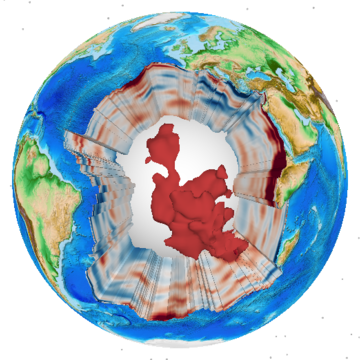
The African Large Low Velocity Province (LLVP) at the core-mantle boundary
What is the proudest achievement in your career so far?
Receiving the Royal Society University Research Fellowship has been amazing, because it's given me complete freedom to pursue my own interests, and supported me financially for many years. That has boosted my career in a way that I couldn't have done without it. I am also really proud of a review chapter for a book that I wrote as a single author on the landscape of the core, because it allowed me to write down my own thoughts on a topic that I’ve been thinking about for many years – summarising what people have already done and thinking about what is important to do next.
How have you found the experience of starting a family whilst being an academic?
In general, I think having a family and being in academia can be very compatible. I waited to have children until I had a bit more stability in terms of funding – I had my first child after I received the Royal Society Fellowship rather than during a short-term postdoc – and I am fortunate to have a partner who has a stable job outside of academia. That is certainly a consideration. But at the same time, academia makes us very flexible and so I can adjust my working patterns when necessary to accommodate doing things with the children, more than my other half who has to be in the office at set times. Some days I leave work early to take my daughter to her swimming lesson and then I make up the time in the evening. I can accommodate this as long as I make sure that my teaching and student meetings are sorted. So, I think that the flexibility in academia actually helps a lot when having children. But, at the same time, academics are very driven and we spend a lot of time working, which clashes with the time it takes to look after the kids. So there is also an aspect of never doing enough work or spending enough time with my kids, and that is a balance that takes time to find, and it will be different for everyone.
What would you say to someone just starting out in Earth Sciences research?
I would advise them to try and first get a broad background, because Earth systems are so intricately linked to each other. You can always specialise later on, but you need to get a really good understanding of how things link together. I think this is a challenge unique to Earth Sciences; learning to think across vast spatial and temporal scales, and to integrate data from across different disciplines. To obtain that breadth, it is important to attend seminars, read literature and have conversations with other researchers.
You're a tutorial fellow at Exeter College. What’s your favourite thing about teaching on our undergraduate course?
I like that through teaching, I get challenged all the time. I get questions from students that I need to think about, especially during tutorials. It's not just that I am saying things to them and they have to take it at face value and absorb it, it’s very interactive. They ask questions, and sometimes I don't know the answer. It is really important for them to realise that sometimes we don't know the answers and we have to go and do some research and find out. That process means that I continuously develop as a teacher, because I need to look things up and try to explain things in a different way, and I really enjoy that.
You are particularly passionate about outreach and public engagement – can you tell us what you enjoy most about sharing science with the next generation?
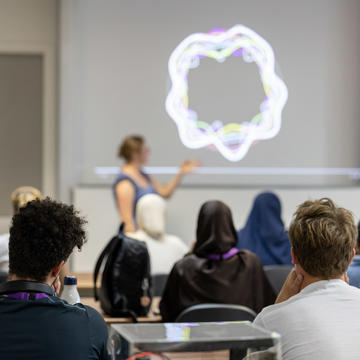
The feeling when you get a response from a kid who says, “Oh, that's cool. I've never thought about that”. And they're really amazed or baffled by it! That is a great feeling, because what you've taught them or shown them might change what they're interested in, and might make them keen to pursue science and give them new goals and aspirations. I really like the fact you can truly amaze them about something.
Have there been any particularly memorable outreach events that you’ve been involved in?
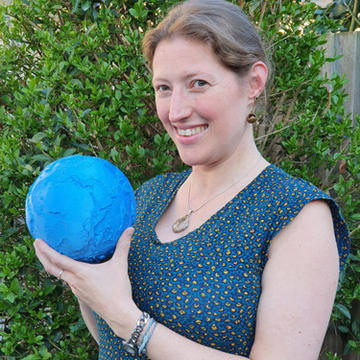
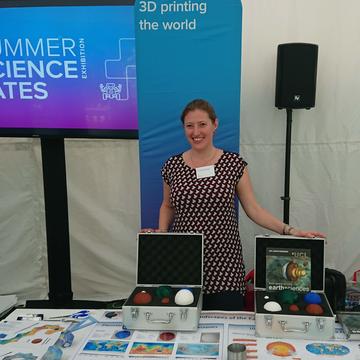
As part of my Royal Society Fellowship, I was invited to present during the evenings at the Royal Society Summer Exhibition, and I developed a lot of outreach materials around 3D-printing for that. We had a special stand and a banner that said “3D-Printing the Earth” on it, which I still have! It was a really great event and our stand was very busy the whole night. Particularly, it was fun showing all our 3D-printed globes in little suitcases, which felt a bit like a magician's hat.
What’s your favourite thing you’ve ever 3D-printed?
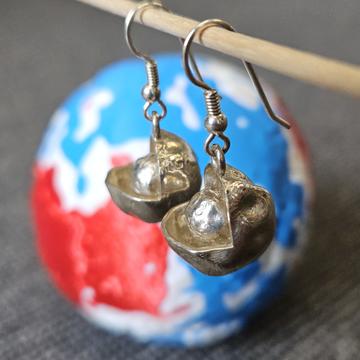
One of my most favourite things was when we got married, we 3D-printed all the vases for the flowers as well as little tessellating birds and fish that people could play with, based on designs from MC Escher. We then gave all these away after the wedding, and when we now visit friends and family, their kids are playing with them, which is really cool! But scientifically, I think that the coolest thing we've printed is the model that I developed during my PhD, which is a model of seismic velocity structures inside the Earth. During a conference, we had a poster with those globes sticking through the paper, and we also developed 3D-printed earring of the same model, giving them away to people attending. For many years, my 3D-printing assistant (or my other half) has tried to have these models printed in silver, and finally last year he managed it!
Lots of your research is centred around theoretical and computer modelling. What do you particularly enjoy about these techniques?
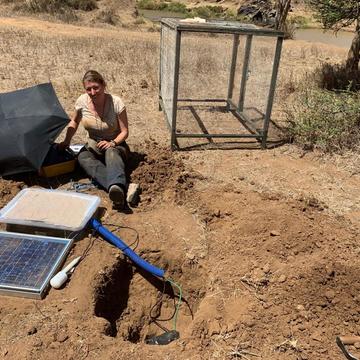
When I was a student, I wasn't sure whether I wanted to do lab work or computational work, so I did a geological lab-based project analysing the properties of salt crystals that are relevant to geological storage. It was useful to try such a project as it basically cemented my feeling that I didn’t want to do lab work! What I like particularly about modelling and computational geophysics is that we can look at lots of different systems in a very similar way. Once we've developed methods of analysing data or inferring models from data, we can apply these to the entire Earth and look at planetary-scale processes. But we can also apply them to a local data set, for example to study fluids in a geothermal system, because the maths and physics remain the same. That said, I really do like being in the field as well, as I used to go on geological fieldwork. Over time I have therefore tried to include more fieldwork in my research, which is now primarily for the purpose of deploying seismometers, so that we can record more seismic data for our modelling.
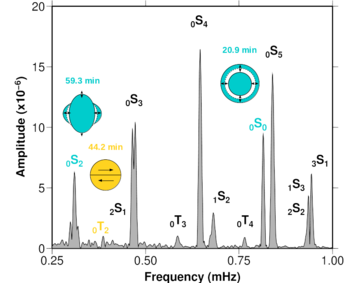
A normal mode spectrum
Normal modes are a big part of your research, but do you have a favourite?
My favourite is 2S16, which I made the first observations of during my PhD. A normal mode is a standing wave of the Earth with a resonance frequency that depends on the properties of the Earth. If you imagine the Earth is a bell that we hit with an earthquake, then it starts resonating at particular frequencies that relate to the structures inside the planet. 2S16 is a special standing wave (a Stoneley mode) that is primarily resonating around the core-mantle boundary. I’ve used it extensively in my research to understand the density structure of the deepest mantle.
What developments in seismology research do you think will happen in the next decade?
Seismology as a field is very much becoming applied data science. We have an explosion in data because instrumentation is cheaper and easier to deploy, and we have the computational power to analyse these data. This is very exciting because it allows us to look at smaller-scale features. AI is a massive opportunity to analyse these data, but we need to take a step back sometimes and be careful in what we’re doing. At the same time, we do not have enough data as we are limited by where we have seismic sensors, and they are typically on land. But land is only about 30% of the Earth’s surface, so when we try to look deeper in the Earth, you get lots of artefacts and biases in our images because of big gaps in our surface instrumentation. Using ocean-based seismic sensors for imaging and understanding Earth structure will be more and more important.
What’s your favourite piece of fiction that involves Earth Sciences?
Journey to the Centre of the Earth from Jules Verne, because it's really interesting to see what he thought was inside the Earth, and what has since changed in our thinking. He imagined all kinds of creatures and crystal caves and that was all possible because we didn't have seismological observations so we didn’t know. A number of years ago, it was a lot of fun to narrate a video produced by BBC Ideas with the Royal Society where we made a scientifically accurate journey to the centre of the Earth. Also, when we were PhD students, we used to have “bad science” film nights where we would watch different science films and comment on them – the blog about these is probably still online [laughs]. One film we watched was called MegaFault and it was about an earthquake fault that was actively rupturing and chasing people until it gets stopped with explosions!
https://www.youtube.com/embed/LUqwHnsLIu8?si=jqV_eoX87Uq128txWas it an entertaining film, if scientifically inaccurate?
It was actually quite entertaining. The behind-the-scenes were even more entertaining because the entire film was filmed on a low budget, and they didn't have the budget to hire a helicopter, so they filmed existing helicopters and used them in their film. And with the explosions, they only had the budget to set off a limited number of explosions, so the same shot would repeat over and over. It was really bad, but fun.
What are you currently working on?
My group primarily tries to develop methods that give us more certainty about what's inside the Earth and enable probabilistic interpretations. We apply these quantitative inference methods to a range of topics, including the topography of the Earth’s core (which has mountains and valleys similar to on the surface), downgoing slabs and the mid mantle, and the upper mantle under the Pacific Plate to study how it’s cooling down. There are also a few projects that are just starting, which I think will be really interesting, where we are connecting seismology with fundamental physics. This will hopefully lead to improved observations of standing waves, and provide combined insights into the structure of the Earth.

