
Earth Sciences in Conversation: Kamini Manick

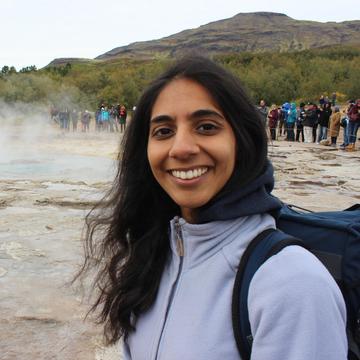
Our Earth Sciences in Conversation series explores the lives and careers of members of the Department, showing readers the people behind our world-leading research. For this issue we sat down with Kamini Manick, Oxford EARTH Programme Manager, to hear about the various roles which brought her full circle back to Oxford, the ambitions of the Oxford EARTH programme, and her advice for those who hope to work at the interface of science, policy and industry.
Interview by Charlie Rex
What (or who) inspired you to get into Earth Sciences?
When I was doing my GCSEs, I realised I really enjoyed geography, but especially physical geography. Volcanoes and earthquakes just seemed incredibly interesting to me. When it came to choosing my A-Levels, I saw that my local college offered geology, which felt like the closest match to the physical geography I enjoyed most, so I decided to take it. I was lucky to have an amazing teacher, Mike Gosling, who was really inspiring and supportive and saw my potential. By the time I was choosing a university degree, I was very clear that I wanted to study Earth Sciences – and I was fortunate enough to come to Oxford to do just that. So for me, it was a combination of a natural interest in the subject and having teachers who really encouraged and nurtured that enthusiasm.
Do you have a favourite part of Earth Sciences?
I’d describe myself as a geology generalist. My career has spanned mineral exploration, planetary geology and engineering geology, so I wouldn’t put myself in one category or call myself a specialist. What I’ve really loved is being able to work and study across different areas of geology and Earth Sciences. That variety really suits me – I think I’m naturally inclined towards it, and I’ve always enjoyed having that breadth rather than focusing on just one niche.
What’s your favourite memory from your time at Oxford as an undergraduate?
One standout memory was our Scotland field trip to Assynt. It was a great trip, really intense, and we experienced some extreme weather. I still remember standing on the side of a mountain watching a blizzard sweep around it – we were all huddled together as it passed over us. But we also had some amazing sunny days. I have so many beautiful memories from that trip. One in particular that has stayed with me was an evening walk as the sun was setting near our accommodation in Assynt. I can still picture the silhouette of the mountains against this incredible purple, blue and pink sky. It was just breathtaking, and it’s always stayed with me.
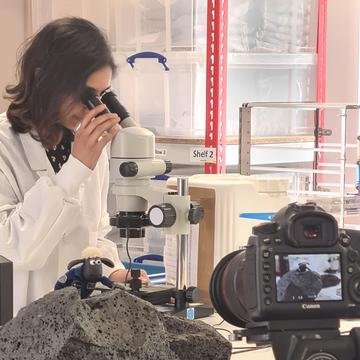
Filming with Shaun the Sheep, 2023
Looking back, what aspects of your Earth Sciences degree do you still draw on most in your work today?
For me, Earth Sciences is incredibly varied. I’ve always described it as applying all the sciences – along with mathematical and computing skills – to the study of the Earth. Through my undergraduate degree, I developed a really broad range of skills, and that’s enabled me to be adaptable throughout my career. It’s given me the confidence to learn new things, move into different areas, and pick up new skills as I’ve gone along. So the variability of the degree, and the adaptability it fosters, is what I’ve really carried with me.
Talk us through your early career – how did you go from Oxford into mineral exploration and the Natural History Museum?
At the end of my undergraduate degree, I knew I wanted to move into the professional world rather than pursue a PhD. I was thinking about what I enjoyed and I knew I wanted to do something related to Earth Sciences, ideally with opportunities to travel. I actually remember googling “geology career travel” to see what came up, and mineral exploration featured heavily. It wasn’t something I’d previously considered, but I was intrigued. After about eight months of applications, I secured a role as a geologist with a mineral exploration company based in London, working on projects in Papua New Guinea, Kenya and Australia. It was a brilliant first job. Within a couple of years I was promoted to project manager, which showed me that my organisational and stakeholder engagement skills were just as valuable as my geology knowledge. I was there for about five and a half years before deciding to do a Masters in Engineering Geology at Leeds. That unexpectedly led to a research assistant role at the Natural History Museum, working on a European Space Agency contract to create a sample analogue collection. We sourced and characterised rocks on Earth that could simulate lunar materials, even collecting two tonnes of material from Iceland. It was a fantastic blend of science, project management and curation, and another example of how varied my career was becoming.
You then moved into programme management – what was that transition like? https://www.youtube.com/embed/I1kyE7DckD0?si=D6XRseJ0ynOT9oBV
After the Natural History Museum, I moved to the Science and Technology Facilities Council into a purely project and programme management role, which was quite a shift because it wasn’t technical or geology-focused. I was working on the UK’s contribution to the European Spallation Source in Sweden, which is a major international science infrastructure project. It was my first experience of a large, government-backed “mega-project”, with complex international politics, member-state contributions, and the scale of organisation needed to manage cost and schedule pressures. I also gained my project management qualification with the Association for Project Management, which allowed me to formalise skills I had previously developed on the job. For the first time, I was working closely with directors and senior leaders, sitting between strategic oversight and day-to-day delivery teams. It gave me a new perspective on leadership, governance and how major scientific collaborations are structured across Europe.
How did that experience lead you to the European Space Agency and, eventually, Oxford EARTH?
At the ESA, I led the laboratory and curation facility we had originally helped establish while I was at the Natural History Museum. I had significant autonomy to develop strategy for the lab, work with the UK Space Agency, and support scientists and engineers building equipment such as lunar rovers and drills. One highlight was travelling to Greenland to visit the only operating anorthosite mine, because that rock is analogous to the Moon’s bright highland regions. We ultimately sourced 40 tonnes of material to create an indoor lunar analogue facility in Cologne, now used for rover testing and astronaut training. When that contract came to an end, I was looking for something locally and saw the Oxford EARTH role advertised. It felt like a natural culmination of my experience in mineral exploration, space, stakeholder engagement and programme management. I’ve been in post for around nine months and it’s been incredibly rewarding to draw on nearly 20 years of varied experience, including relationships I built at the very start of my career, which are still relevant to the critical minerals and sustainability work we’re doing now.
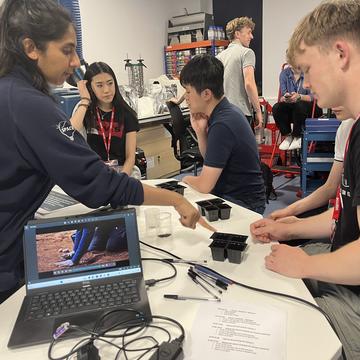
During Discovery Week, 2024
Can you describe what Oxford EARTH is and what it aims to achieve?
Oxford EARTH stands for Equitable Access to Sustainable Resources for a Thriving Habitat. At its core, it’s about the future of resources, particularly minerals and metals. People hear a lot about critical minerals in the news, especially given recent geopolitical developments, and our focus is on how the future of mining can be done better – more sustainably and more equitably. By equitable, we mean ensuring there is a genuine social licence to operate, particularly in regions where historically the benefits of mining haven’t always been fairly distributed. The programme is inherently interdisciplinary, bringing together physical and life sciences with social sciences. Some of our researchers are working on the circular economy, looking at how we can prioritise recycling materials that have already been extracted and used. Where new mining is necessary, we’re exploring how to minimise environmental impact and improve community engagement. We’re also investigating new ways of recovering resources, such as using microbes to produce metals – still very much at the experimental, lab-based stage – and extracting minerals from geothermal fluids, which are already used for energy production. For example, we have a project in Montserrat testing geothermal fluids for target minerals to see whether resource recovery could become a dual component of geothermal energy operations. Overall, it’s a varied and ambitious programme that looks at the intersection of disciplines to rethink how we access and manage the resources needed for the future.
How is Oxford EARTH going to bring together different academic, industry, and policy perspectives?
At the moment, much of that engagement happens through our researchers, many of whom already have strong links with industry, policymakers and NGOs, and they collaborate with those partners on individual projects. What we’re now looking to do is build that engagement at a more strategic level across the whole programme. For example, we’re running a stakeholder workshop over the summer where we’ll bring together a wide range of voices to help shape our research strategy. From there, we plan to establish an ongoing stakeholder group to provide continuity, advise us, and ensure regular dialogue. In the longer term, we’ll also set up an advisory board made up of representatives from academia, industry, policy, government and NGOs. The aim is to integrate those perspectives into the structure of the programme, rather than engaging them in isolation. We’re also exploring more concrete collaborative initiatives – for instance, developing an executive education course in partnership with industry, where there’s mutual benefit and shared objectives. It’s about being intentional and structured in how we build and sustain those relationships.
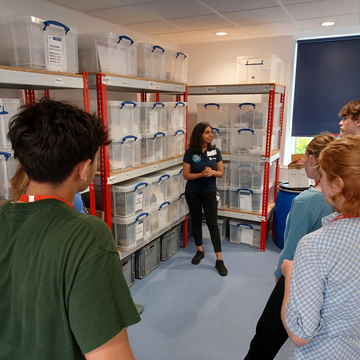
During Discovery Week at the European Space Agency, 2023
What does a typical day look like for you as Programme Manager?
It really depends on what phase we’re in. If we have a major event coming up, that tends to shape my days, because those events involve a lot of organisation and planning, so I’ll usually be working on something related to that or in meetings about it. Alongside that, I’m preparing for programme board meetings, handling administrative matters like business cases or correspondence, and meeting regularly with my team to stay on top of ongoing issues. I also spend time engaging with our co-investigators and researchers across Oxford EARTH, because there’s a constant flow of new ideas coming in – either from within the programme or from colleagues across the University who are working on related topics. One of the most exciting parts of the role is hearing about those ideas and figuring out how to support them, whether that’s helping develop a funding application, finding a budget to run an event, or connecting people with the right collaborators. So even when there isn’t an event on the horizon, there’s always a lot going on – the balance just shifts depending on the workload at the time.
Why does the work around critical minerals and sustainable resource management matter right now?
Resources have always been fundamental to humanity – whether for making tools, building homes or developing new technologies. But right now, the conversation is especially urgent because of the clean energy transition. Moving towards renewable energy systems requires significant amounts of critical minerals, and at the same time the growth of AI, data centres, aerospace and defence all place additional demands on resources. These are essential priorities, but we don’t want to meet them by repeating the mistakes of the past or continuing with business-as-usual extraction practices. So the question becomes: how can we access the resources we need in a better way? At Oxford EARTH, that means looking at how resource recovery can be more sustainable, with minimal environmental impact, and more equitable, ensuring there is genuine social licence and that local communities benefit rather than bear disproportionate costs. It’s about recognising that the materials underpinning modern society don’t just appear – they’re grown or mined – and thinking carefully about how we manage that reality responsibly for the future.
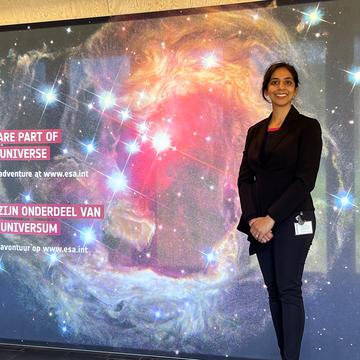
At the European Space Agency, 2024
What is the biggest challenge you face in coordinating such a wide-ranging interdisciplinary initiative?
I’d say the biggest challenge is simply coordination in a very busy and distributed environment. Our researchers are spread across different departments and buildings around the University, so we don’t naturally see everyone every day. Even within Earth Sciences, people are often travelling, working remotely, or juggling multiple commitments. University schedules also fill up very quickly, so planning well in advance is essential – sometimes six months ahead for larger meetings or initiatives. Researchers are typically involved in several projects at once, so there are always competing demands on their time. For me, that means being very clear and thoughtful about how and when we engage people, making sure communication is efficient and that anything we’re asking of them feels genuinely useful and worthwhile. It really comes down to careful planning and being intentional about how we bring people together.
What’s something about your job that would surprise people?
One thing I really value, and that might surprise people, is how much freedom I have to bring my own experience into the role. Of course, I’m doing what was outlined in the job description, but there’s also real space to draw on my own background and interests. For example, my experience in space resources and my time at the European Space Agency weren’t originally a core focus of the programme, but they’ve been recognised as a valuable and interesting perspective to bring in. That’s allowed me to introduce new ideas and reconnect with colleagues and contacts in the space resources field, adding another dimension to Oxford EARTH. So while I’m very much in a programme management role, there’s genuine scope to shape and contribute to the direction of the work in a way that feels meaningful.
Given your experience, what advice would you give to graduates who want to work at the science–policy–industry interface?
I’d say be open to different kinds of experiences. There were things I was very focused on at the start of my career, and I was fortunate to pursue them, but some of the most valuable opportunities were ones I hadn’t planned for. I never set out to become a project manager – I initially just wanted to focus on geology – but it turned out I had natural strengths in that area, and project management has really been my passport to a wide range of roles and experiences. It’s given me highly transferable skills that work across science, policy and industry. So I’d encourage students to stay open to opportunities they might not have anticipated, seek out good mentors, and be willing to lean into roles that weren’t necessarily part of the original plan.
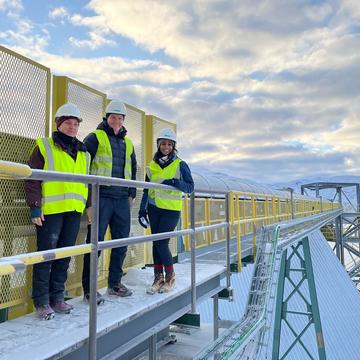
At the Lumina Mine in Greenland, 2023
Have there been mentors or role models who influenced your path?
I’ve actually had quite a few mentors and role models, and they haven’t always been my direct line managers. Often the most influential people have been those working in different departments or divisions within the same organisation. That’s been incredibly valuable because it’s given me perspective. When you’re focused on one project, it’s easy to get lost in the details, but having mentors who could step back and offer a broader view really helped me think more strategically. They’ve helped me see the bigger picture, especially at times when I might have been worrying about the impact of something within my own project. That wider perspective has made a big difference throughout my career.
Looking back, what would you tell your younger self on graduation day?
On graduation day I hadn’t secured a job yet, so I was probably worrying about whether I’d find one and what direction I’d take! Looking back now, nearly 20 years into my career, I’d say: don’t worry. At the time I knew I wanted to work in mineral exploration, even though I hadn’t landed a role yet. I stayed focused, kept applying, and eventually got there. So I’d tell my younger self to trust that focus, keep going, and have confidence that things will fall into place.
What has been the proudest moment in your career so far?
I’d say one of my proudest moments was when I was at the European Space Agency and had a team of four student interns working with me. It was incredibly rewarding to draw on everything I’d learned throughout my career to support and mentor them. They had just three months to complete quite an ambitious programme of work – including literature reviews, lab work, analysis and final write-ups – so there was real pressure on time. I was a bit nervous at the start, but applying my project management skills meant I could create a clear structure around them, which allowed them to focus and thrive. Watching them grow in confidence, work collaboratively and produce excellent research was a real privilege. Seeing that team come together so successfully was definitely a highlight for me.
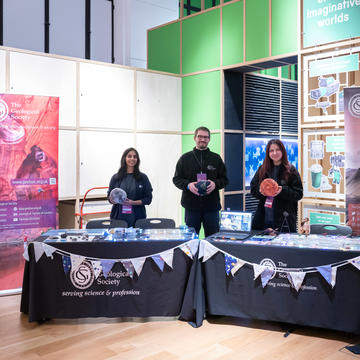
At the Science Museum with the Geological Society, 2024
What are you most excited about in the next year?
I’m really excited about our upcoming stakeholder workshops. We’ll be using a methodology developed by colleagues at Saïd Business School, which is designed to help people have constructive conversations around controversial or difficult topics. Mining, in particular, brings together a wide range of perspectives, and we’re deliberately inviting stakeholders who may not all agree with each other. The aim is to create a safe space where those different, even conflicting, voices can be heard and engaged with thoughtfully. I’m fascinated by how that process might generate new ideas and shape how we design and prioritise our research going forward. I’ve never worked with this methodology before, so it will be a new experience for me, but I’m really looking forward to seeing how bringing together diverse perspectives can help us do better, more innovative work.
Do you have a favourite piece of fiction that involves Earth Sciences?
I don’t even have to think about this one. For me, it has to be Jurassic Park. I was eight years old when I saw it in the cinema – probably a bit young, looking back – but it was honestly one of the most exciting days of my life. I went with my dad and my sister, and the cinema in Preston had all ten screens showing Jurassic Park, with queues stretching out into the car park. It was incredible. I absolutely loved it, and I still rewatch it every couple of years. As an adult, I notice different things – especially the scenes where the scientists are debating the ethics of the park. That discussion has a completely new meaning for me now, and I think it’s one of the most compelling portrayals of a scientific and ethical debate on film. I also really enjoyed Deception Point by Dan Brown, which centres around a geologist and is set in the Arctic. It’s a fast-paced thriller and I remember finding it really exciting – it’s been a while since I read it, but it definitely left an impression.

