


Earth Sciences in Conversation: Gideon Henderson

Our Earth Sciences in Conversation series explores the lives and careers of members of the Department, showing readers the people behind our world-leading research. For this issue we sat down with Gideon Henderson, Professor of Earth Sciences, to discuss approaches to climate mitigation, his time as Chief Scientific Advisor at DEFRA, and fieldwork in Siberian Russia…
Interview by Charlie Rex
What (or who) inspired you to get into Earth Sciences?
I think it was a combination of a love of the outdoors and a love of science. I really enjoyed doing science when I was studying at school – as much as you enjoy anything when you're at school! – but that was the bit that lit me up most. I've always loved being outside in the hills and by the sea. The combination of understanding the planet through the application of science and doing it outdoors is what really brought me into the subject.
Tell us about your university journey
I was very fortunate to get into Oxford as an undergraduate. I went to a comprehensive down the road and I applied as a bit of a long shot. I didn't get into my first choice of college, but I did get into Oxford! I loved it (with all the normal caveats of feeling like a bit of an imposter and like I wasn't good enough to be here) but thrived in the environment and enjoyed learning about Earth Sciences. I took a gap year when I finished but always knew that I wanted to come back and do a PhD. I did a PhD at the University of Cambridge supervised by Keith O'Nions, who was an inspirational geochemist, and that was when I really started focusing on the geochemistry of the planet.
Where has your career taken you so far?
After my PhD I was fortunate enough to get a postdoctoral fellowship at the Lamont–Doherty Earth Observatory at Columbia University, which was a two-year position. I worked with Wally Broecker, who is widely recognised as the person who coined the term “global warming”, and also worked out ocean overturning circulation. But also, from my perspective, he did some of the impressive early work with the uranium series. U-series is the set of geochemical tools that I often use in my research to try and understand the age of things and how quickly processes happen. I wrote a couple of successful grants, stayed there for two more years, and then got a teaching position back here in the Department. Now I've been here for something like 25 years, although I've spent the last six of those working for the UK Government as well as the University.
What were some of the highlights and challenges of your time as Head of Department?
Probably one of the highlights – and one of the challenges – was that by the time I became Head of Department, we were just moving into the new building. I’d been heavily involved in designing it and making sure the labs worked, but then I had the job of making the Department move from one place to another. And that is, quite surprisingly, difficult! It's amazing how the culture of a place is embedded in the building. Getting everyone to settle into a new place and stay as a happy family was an early challenge. But I was proud of how we handled those changes. As a scientist, I was also particularly proud that we were top of the REF [Research Excellence Framework] rankings. It was the first time we were the number one department and we knocked Cambridge off the top spot, which makes it even more precious!
You recently returned from a secondment to DEFRA as their Chief Scientific Advisor. How did that opportunity come about?
I've been on a journey as a scientist, like many people do. I started off wanting to discover stuff and although I knew I was never going to win a Nobel Prize, that curiosity-driven stuff motivated me for a long time. And then as I progressed through my career, I realised I wanted to do stuff that is going to have some impact for society. More and more I found myself thinking about the science impact on policy. I wrote a report on ocean resources with the Royal Society that was commissioned by the Foreign and Commonwealth Office, and the Greenhouse Gas Removal report which was commissioned by BEIS [the Department for Business, Energy and Industrial Strategy]. I loved writing those and wanted to find a role that had more of that. And then the DEFRA Chief Scientific Advisor role was advertised. I applied for it, went through what is still the most rigorous application process I've ever been through, and was fortunate enough to get it!
What made the DEFRA application process so rigorous?
The number of interviews, and that they get you to have conversations with psychologists. They also got me to do something called a staff engagement exercise, which I think is really good, and I’ve used it a lot when I’ve recruited people since. They send you into a room with about six to eight people from different levels who you will end up working with if you get the job. You talk to them for about 45 minutes, and a psychologist is sitting in the corner listening to you and taking notes. You can't see them, but you know they're there! They’re questioning whether you get on with people? Are you a good leader? Are you a good conversationalist? Can you draw people in? Are you polite? And then afterwards all the people you were talking to write notes on you. That was a new ordeal!
How was your experience with DEFRA different to the world of academia?
There are a few things, one of which is that the pace of work in the civil service is phenomenally fast. As a research scientist, you're used to being able to go away and think about something, read the literature and then come back with a considered view in a year when you've done some more research. At DEFRA, you go in and talk to the minister, they want an answer right then, and if you don't know the answer you come back the next day. So it's really speedy delivery. Secondly, the civil service is quite hierarchical and people tend to defer to grade. If you talk and you're more senior than other people, everyone's going to shut up, so you actually don't get good ideas from people if you talk too much. And finally, academics love to find out why the other person is wrong – when someone starts talking about what they’re doing, everyone is trying to find the faults and the weaknesses. But that's not the way that civil servants normally work. There's much more deference and much more agreement with each other. I think that’s one of the reasons why they bring in chief scientists - they want someone from outside with a different viewpoint who's willing to speak their mind and be a bit blunt. It’s also why it has term limits - after you've done it for five or six years, then you've probably lost that edge.
Can you tell us a bit about what you did as Chief Scientific Advisor?
I led the science and analytical functions. That meant that I was in charge of the budget – and it's substantial! In my last year it was £256 million R&D, and I had to bid for that budget from the treasury. It’s basically the biggest proposal you’ve ever written. I then had to distribute that money and make sure it's spent on the right things. I was also on the executive committee, and that's the body that decides what DEFRA is going to do and really delivers the support to the ministers.
Presumably not all of DEFRA’s remit is within your scientific area of expertise. How did you approach expanding your knowledge?
I went in thinking that as a geochemist who has deliberately worked in quite a lot of different areas, I had pretty good coverage. I've worked a lot on the ocean, soils and rivers and I’ve thought quite a lot about nutrient cycles and pollution, so that is all familiar to me. But what I’m much weaker on is the health side of things. So it was quite ironic that within about six weeks of me starting, we started to hear about this disease from Wuhan. I didn't know anything about viruses at the time, but I sure as hell had to learn quickly! That was something that was definitely outside my comfort zone. But I think one of the lessons is that if you're a good scientist and you've worked in science for a little while, the skills and the tools that you get are actually quite transferable to other bits of science. If you understand how science works, you can transplant into something completely different and still talk with other scientists and understand what they're talking about.
How much does the government listen to scientists?
I worked with six different Secretaries of State and quite a lot of junior ministers and nearly all of them really wanted to hear the science. I always felt that I was listened to. And I think that they like having a system which deliberately channels science to them. The UK is quite good at having a number of mechanisms by which science is heard. They didn’t always follow the evidence, but we always have to recognise that ministers are making decisions based on a hell of a lot of other stuff apart from the scientific evidence. We live in a democracy, so they're certainly thinking about what people are going to vote for. But they're also thinking about the finances of the country, what's going to work in a particular place, what will please their constituencies, and what's going to play out internationally and diplomatically. All these things have to be factored into their thinking, so it’s not surprising that they don't always follow the science.
How can academics and the government work together better?
I think both sides need to try and understand the ways in which the other side work. For example, one of the things that I say people should really be aware of when trying to offer scientific input is to be neutral and objective. Ok, you need to tell them what the facts are and what the pros and cons are, but don’t tell them what to do. They want to be able to make their own decision. And as soon as you start giving an opinion, they'll start thinking that your evidence is biased. I also think it's really important that you describe all of the evidence rather than just cherry pick. Most of the big arguments that happen around science in government are when a particular group of people use half the data to make their case, and another group use the other half. You've got to try and be willing to express all of the data, and be open and transparent.
Do we already have the right tools to tackle climate change, or are we still waiting on new technologies?
We have quite a lot of the tools that we need, maybe not all of them. But in most cases, we're just not applying those tools enough and we're therefore not learning more about them. If you look at the challenge of mitigation and you break it down into individual parts like energy and food and transport, for each one of those parts you can see how we might solve the problem. We've made quite a lot of strides on some of them. With energy, for instance, the UK has taken a lot of our fossil fuels out of the mix. But with other challenges, we have the technologies we need but we haven’t sorted how we are going to use them. The missing application for energy is storage. We have a fairly good amount of knowledge about how we might store energy, but we haven't quite settled on the right one to pursue at scale.
What do you think is the most effective method of carbon removal that the UK can implement?
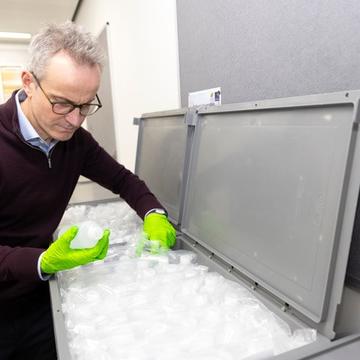
The challenge is not just taking it out of the atmosphere, but putting it somewhere. We're currently putting some of it into organic carbon, mostly trees, and there’s a bit more we can do there, but we definitely can't put enough of it into those places. So we need to store significant amounts elsewhere. I believe there are only two places that we can do that: one of which is to put it underground into rocks, and the other one is in the ocean. There's a hell of a lot of carbon in the ocean now, about 40 or 50 times more than the atmosphere, and therefore a relatively small change in the ocean storage of carbon can make a very big difference to the atmospheric values. In terms of what's going to be the most effective, I think it's going to be one of the mechanisms by which we take carbon and put it into one of those places. It's got to end up securely stored under the ground in rocks or in the ocean, and I think probably we're going to need both of those.
Much of your research has been concerned with past climate change – how important do you feel that is for solving current challenges?
There is no time in the past that is exactly like the future will be. So what we have to do is to try and learn from the past not by direct analogy but by understanding the processes. If we want to learn what's going to happen to sea level in the future, we can look back in the past and say, well, what were the processes that caused sea level to change, how much did it change, how quickly did it change, and then take that understanding and try and apply it to the future. I think it's also important to say that understanding the past is just fun. For example, thinking about where life comes from is probably not really that useful to society, but everyone's curious. It’s an interesting question in its own right. The same is true for palaeoclimate.
What is the proudest achievement in your career so far?
Oh, that's a tough question... Right above my desk I've got all of the PhD theses of my graduate students lined up, and I'm proud of the body of work that they have done as individuals. My involvement in helping them to learn and to become the next generation of scientists is something I'm definitely proud of. Lots of them are leading their own labs and their own research endeavours now. And that's something I see as my legacy; all the people I've helped along the way.
Tell us about the coolest sample you have ever worked on?
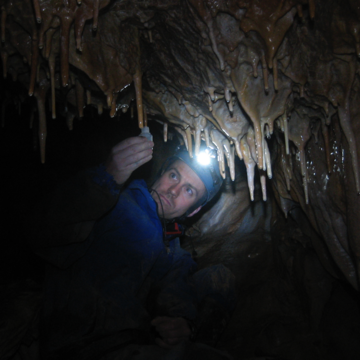
I'm not sure what defines cool here! One of the curious things about being a geochemist, especially when you try and work on very high-resolution climate, is that you end up working in absolutely exquisite detail on a tiny little sample. From the biggest stalagmite we worked on from China, which is more than two metres tall and really wide, we ended up doing some of our most important work – about the 8.2 ka event – on a 2 cm2 piece of carbonate. We literally took thousands of samples from this tiny square, and worked on it for years. I think its cool that this little piece from a great big stalagmite revealed so much about Earth’s history.
Where is your favourite place in the world to do fieldwork?
Favourite place in the whole world? I’m going to have to cheat and do one land and one ocean, sorry! My favourite terrestrial location is the caves in Siberia that we worked on when we were reconstructing permafrost. We flew into Irkutsk, which is an interesting city in its own right, and then we drove along this dirt track for miles. We filled up with petrol from this amazing gas station, which was one little pump in the middle of nowhere. Then we kept on driving and at some point the driver just turned left off the road. There didn't seem to be a trail there, but we just went off through the woods, cutting down trees where we needed to, so we could keep driving. We drove through this river that no car I've ever owned would possibly have got through. And then we found these caves that we knew about because they were used by local hunters in the winter. We got some really cool samples from there, it was a wonderful experience. And in terms of a marine setting, I have really enjoyed working in the Bahamas. I did some of my early work there to try and understand the timing of climate change. It’s a lovely warm environment and a beautiful sea and you can really see the geology shaping the planet around you.
What’s your favourite piece of fiction (book, movie, TV show, song) that involves Earth Sciences?
It's not really a favourite film, but it has been quite useful to me - The Day After Tomorrow. It's a fairly rubbish film, but it's quite gripping. It came out at a time when I was working on abrupt climate change, and that's exactly what it's about. I was being funded by someone called Gary Comer, a businessman who got interested in climate change and was funding a group of scientists, and he was very interested in it as well. So when the film came out, it was a quite a big deal. We were all interested in how the science was going to be portrayed. I have used it subsequently as a teaching tool – I get students to work out what's wrong with the science, because there's really quite a lot that's wrong! And if you have taught a lecture well, you can then show a clip and ask them to point out the flaws, and they'll spot what's wrong with it because it's so badly wrong.
Have you had any particularly influential mentors or academic inspirations during your career?
My PhD supervisor, Keith O’Nions, was definitely an inspiration. I'm still in touch with him, as he lives in Oxford and we see each other occasionally. The other person who was inspirational was Nick Shackleton, who is widely recognised as being the person who worked out how to use oxygen isotopes to interpret past climate, and himself did a lot of really important work using that tool. Although Keith was great at the geochemistry, he didn't know about some of the stuff I was studying, so the only way for me to get answers was to go and bang on Nick's door and get him to help me out! So those two at Cambridge stand out, and then from my time at Columbia, two figures: Wally Broecker, who I've mentioned already, and Bob Anderson, who is perhaps less well-known, but has done a tremendous amount of science to understand climate and use geochemical tools. Together with him, we initiated a big international programme called GEOTRACES, which aims to understand the chemistry of the ocean. It was really Bob’s inspiration to start that programme that drew me into the ocean chemistry side of things.
What are you currently working on?
Most of the work that I kept going when I was still at DEFRA was to do with carbon dioxide removal, and that's what I'm ramping up a little bit. I'm really thinking about how it operates, both on land and in the ocean. When you're trying to do carbon dioxide removal, you are accelerating a natural process, and because a lot of the geochemistry that I've studied through my career has been understanding those, I'm able to use that knowledge. I'm also more widely interested in the oceans. I think there's a lot of work still to do to better understand the ocean, particularly as we are starting to use it in new ways: extracting energy from it, mining from it, and storing our carbon underneath. There's science to be done around the edges of that.
Finally, what are some “good news” climate stories that don’t get enough coverage?
The big “good news” story about climate is that we can predict it and we know what the consequences of our actions are going to be. We are in a position to make decisions and we have some power over that. And that has come about through science. That's a “good news” story that we shouldn't lose sight of, because it has led to a global agreement that we have to do something about climate. We're not doing it fast enough, but we are doing something in that we have reduced emissions relative to where they would be and there continues to be a global endeavour to go further. So I think the trajectory is not as bleak as it might be. We just have to ramp it up and go faster than we're going now.

