


Ancient global warming was amplified by widespread forest fires and soil erosion
By Dr Joost Frieling
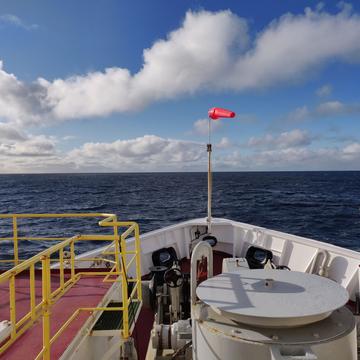
The International Ocean Discovery Program expedition vessel in the Norwegian Sea, 2021 (Image Credit: Dr Joost Frieling)
56 million years ago, during the Paleocene-Eocene Thermal Maximum, the temperature of the Earth rose almost as rapidly as during present day anthropogenic warming. To explore the changes to the carbon cycle which happened at this time, we analysed a unique, undisturbed sediment archive from offshore Norway, which allowed us to examine this interval in closer detail. The results, which were published this week in PNAS, showed that large-scale deforestation, wildfires and erosion affected large parts of the Earth’s surface. High resolution analysis revealed that these effects may have occurred within as little as a few centuries after a huge amount of CO2 entered the atmosphere, and lasted millennia.
56 million years ago the Paleocene-Eocene Thermal Maximum (PETM), a period of rapid global warming, occurred. Within the span of a couple of millennia, temperatures rose by 5 degrees, triggered by a huge release of carbon. Due to its likeness to present-day warming, the PETM is often used to test the long-term environmental response to large-scale perturbations, making it a very scientifically valuable climatic event to study.
To reconstruct the changes in vegetation that occurred during the earliest phases of the PETM, we analysed fossil pollen and spores recovered from a unique, undisturbed, laminated sedimentary archive acquired during an International Ocean Discovery Program scientific drilling expedition to the Norwegian Sea back in 2021 – which my co-author Professor Henk Brinkhuis and I were fortunate to have been a part of. The study was led by Mei Nelissen (PhD student at Utrecht University and the NIOZ, Netherlands) who isolated these organic fossil pollen and spores from these ancient sediments using strong acids. As many of the plants that grew along the North Atlantic margins still exist today, she was able to determine the origin of these pollen and spores, providing vegetation composition in snapshots of ~10 years each, most of them less than 100 years apart.
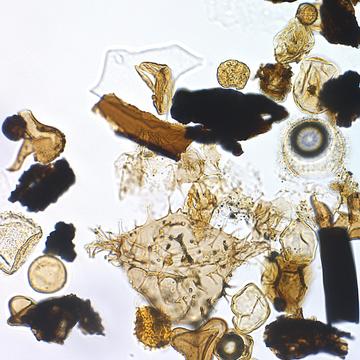
Microscope slide from the study, showing masses of fern spores, plant remains and some charcoal (Image Credit: Mei Nelissen)
It is an understatement to say the results were surprising; the changes in pollen and spores illustrate an almost complete loss of coniferous forests and a subsequent shift to ferns, often the first colonisers after a major environmental disruption. Perhaps even more remarkable was that the loss of the coniferous forest and expanse of fern-dominated vegetation appears to have occurred in – at most – a few centuries. It is exceptionally rare to see such rates of change so clearly recorded in geological archives. A coeval increase in charcoal, a product of forest fires, and clays that signal deep erosion, provide further evidence for rapid deforestation at the time.
At the onset of the warming during the PETM, an initial release of CO2 from volcanic activity or other sources may have pushed the vegetation over the edge – it indicates that, similar to present-day but highly unusual for the past periods of climate change, the changes in temperature and rainfall patterns may have been too quick for vegetation to adapt or migrate.
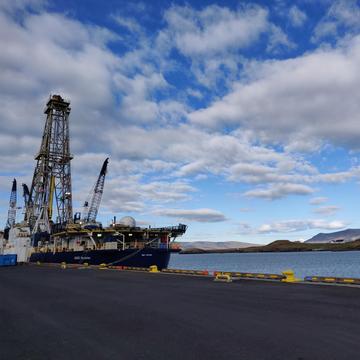
The IODP vessel in the harbour of Reykjavik, 2021 (Image Credit: Dr Joost Frieling)
As we looked beyond the sedimentary archives from offshore Norway, it became clear the fern-dominated vegetation and soil erosion were in fact much more widespread, and that simultaneous changes were recorded on the Atlantic margin in New Jersey, Svalbard and in South Australia. Such a widespread and sudden change in vegetation, fire regime and soil stability, previously only associated with the most severe mass extinctions in Earth’s history, has major knock-on effects in the climate and carbon cycle.
This is primarily because forests and soils themselves hold large amounts of organic carbon which, if disrupted to such an extent, will be broken down and re-emitted as CO2, thereby acting as a positive feedback to an initial rapid warming. Because the temperatures in the late Palaeocene were already much warmer than today, and lush vegetation had grown even at high latitudes, this release of organic carbon was very large. We find that deforestation on the scale that may have occurred during the PETM may have amplified the initial CO2 release by as much as a third or more – highlighting the potential for disruption of ecosystems on land to exacerbate past and current climate change.
The study “Widespread terrestrial ecosystem disruption at the onset of the Paleocene–Eocene Thermal Maximum” is available to read in the journal Proceedings of the National Academy of Sciences (PNAS) at https://doi.org/10.1073/pnas.2509231122.

